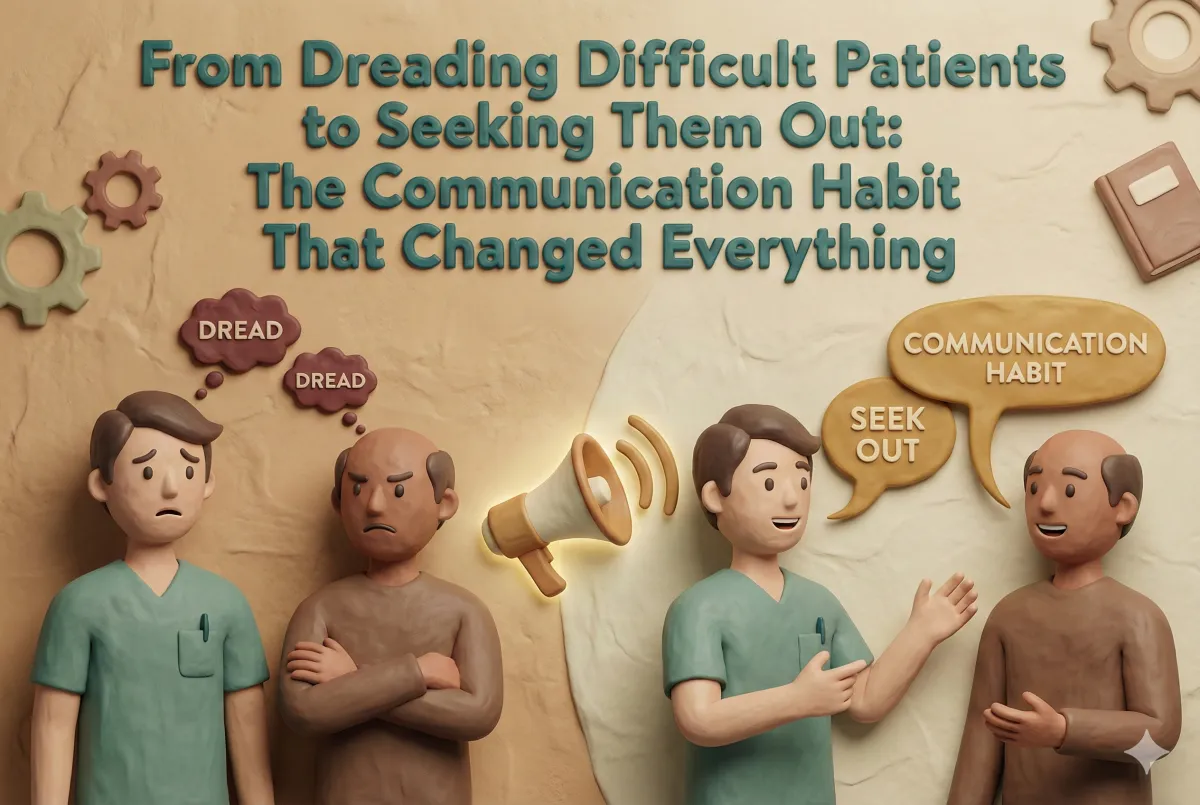
From Dreading Difficult Patients to Seeking Them Out: The Communication Habit That Changed Everything
I need to be honest about something.
There were patients I used to dread seeing. Not because they were unkind or demanding, but because our conversations felt like Groundhog Day—the same barriers, the same excuses, the same lack of progress, week after week.
The chronic canceller who'd reschedule three times then no-show. The person who couldn't find fifteen minutes for exercises but had hours for scrolling. The sceptic who'd "tried everything" and was already convinced I couldn't help either.
These interactions left me frustrated and exhausted. I'd look at the next day’s schedule and feel my stomach tighten when I saw certain names.
I knew this reaction wasn't fair to them or helpful to me. But I couldn't seem to shift it. The frustration felt automatic, like a reflex I'd developed after years of similar conversations that went nowhere.
Then I discovered something that really helped me—not through revolutionary new techniques or massive effort, but through the smallest possible shift practiced consistently.
James Clear writes: "Habits are the compound interest of self-improvement. The same way that money multiplies through compound interest, the effects of your habits multiply as you repeat them."
My frustration was a habit. And habits, I learned, could be replaced.
I started with one tiny change: replacing frustration with curiosity. Just that. Nothing more complicated.
I had no idea this microscopic shift would completely transform not just how I worked, but how I felt about my work.
I'll share with you what happened with three specific patient types who used to make me dread Friday afternoons.
Patient Type #1: The "No Time" Person
Before: Frustration and Judgement
Meet David (or at least, meet the version of David I saw through my frustration-clouded lens).
David was a 45-year-old office manager with chronic lower back pain. Intelligent, articulate, clearly wanted to get better. And yet, week after week, he'd return having done maybe one of the five exercises I'd prescribed.
"I just didn't have time," he'd say, looking genuinely apologetic.
My internal response? Everyone has fifteen minutes. You just don't prioritise it. If you really wanted to get better, you'd make time.
My external response was more diplomatic, of course. I'd gently explain—again—the importance of consistency. I'd offer to simplify the programme. I'd suggest scheduling exercises like appointments.
Nothing changed. And with each failed attempt, I became more convinced David simply wasn't motivated enough. I started to resent the time I was investing in someone who clearly wasn't going to do the work.
The Shift: What Curiosity Revealed
After reading about compound habits, I decided to try something different with David.
When he returned having done the exercises once, I noticed my familiar frustration rising. But instead of letting it take over, I paused and got curious.
"David, I'm genuinely interested—when you think about doing these exercises, what goes through your mind?"
He looked surprised by the question. There was a long pause.
"Honestly? I feel like I'm already failing at so many things. Adding one more thing I'm going to fail at just feels... overwhelming."
There it was. The real issue had nothing to do with time.
"And what else makes this feel hard?" I asked, staying curious rather than jumping to solutions.
"I guess... my wife thinks physio is a waste of money. She's not wrong—I've been coming for months and I'm not better. Part of me wonders if she's right."
In five minutes of genuine curiosity, I learned more about David's barriers than I had in three months of explaining exercise benefits.
After: A Different Relationship
Once I understood what was actually stopping David, we could work with his reality instead of my ideal plan.
We didn't add exercises. We removed them. Just one exercise he felt he could do whilst his coffee brewed in the morning. Something so small it didn't register as another thing to fail at.
More importantly, I stopped measuring David's success by exercise completion and started measuring it by whether he felt heard. Our conversation helped us both understand his own barriers.
David still doesn't do exercises perfectly. But he comes consistently, he's engaged, and his pain has improved. Not because I finally convinced him to prioritise treatment, but because I got curious about what was really going on.
These days, when a patient says "I don't have time," I feel a spark of curiosity instead of a wave of frustration. What else is underneath that statement? What am I about to learn?
Patient Type #2: The Chronic Canceller
Before: Taking It Personally
Meet Jennifer, the patient who made my reception staff groan when her name appeared on the schedule.
She'd book. She'd cancel within 24 hours. She'd rebook. She'd no-show entirely. Rinse and repeat.
My internal narrative about Jennifer was harsh: She's wasting everyone's time. She clearly doesn't actually want help. She's one of those people who loves being a victim of their condition.
I felt disrespected. My time was valuable, and she was treating it as disposable. When she'd eventually show up, I'd be pleasant but distant. Why invest in someone who clearly wasn't invested in getting better?
The Shift: What Curiosity Uncovered
After several months of this pattern, Jennifer booked another appointment. The old me would have expected—perhaps even hoped for—another cancellation.
The new me, practicing curiosity, decided to explore what was really happening.
When she arrived (surprisingly, on time), I tried something different.
"Jennifer, I've noticed a pattern with appointments, and I'm curious about something. What makes it hard to come consistently?"
She looked down. "I know I'm terrible at keeping appointments. I do this with everything—dentist, doctor, even meeting friends. I feel awful about it."
"That sounds genuinely hard," I said. "And what else is going on when you're about to come in?"
Long pause. Then: "Honestly? I'm terrified you're going to tell me I'm not getting better because I'm not doing enough. My husband already thinks I'm faking how bad the pain is. I can't handle someone else implying I'm not trying hard enough."
My stomach dropped. I'd been so focused on feeling disrespected that I'd completely missed her fear of judgment. And by being distant when she did come, I'd probably confirmed her worst fears.
After: Addressing the Real Barrier
Once I understood Jennifer's pattern came from fear rather than disrespect, everything changed.
We created a new agreement: she'd commit to one appointment a month, no pressure for more. If she needed to cancel, she'd text me directly (not reception) with a simple "need to reschedule." No explanations required. No guilt.
At appointments, we spent the first five minutes just talking—not about exercises or pain, but about what was actually happening in her life. I made it explicitly clear that my job wasn't to judge her effort but to help her find what was manageable.
Jennifer now comes monthly like clockwork. Sometimes she's done exercises, sometimes not. But she's honest about it because she knows I'm genuinely curious about what got in the way, not disappointed that she didn't comply.
The relationship transformed because I stopped interpreting her cancellations as disrespect and got curious about what they actually meant.
Now when patients cancel repeatedly, I don't take it personally. I get curious. What's the fear? What's the shame? What am I missing?
Patient Type #3: The Sceptic
Before: Trying to Prove Myself
Meet Robert, a 60-year-old tradesman with osteoarthritis in both knees.
From the moment he walked in, his body language screamed resistance. Tense. Minimal eye contact. His opening line: "My wife made me come. I've tried physio before. Didn't work."
My immediate reaction was defensive. I felt like I had something to prove. If I could just demonstrate my expertise thoroughly enough, explain the evidence clearly enough, show him why my approach was different, surely he'd come around.
So I did what I'd been trained to do: I educated. I explained biomechanics, showed research, outlined my successful outcomes with similar cases. I was thorough, professional, evidence-based.
Robert remained unconvinced. He'd nod politely but I could tell he was just waiting for me to finish. He returned once, grudgingly, then didn't rebook.
I felt like I'd failed. My expertise hadn't been enough to overcome his scepticism.
The Shift: Stopping the Convince-Resist Dance
Months later, Robert's wife booked him in again. Same presenting complaint. Same sceptical demeanour.
But I was different this time. I'd been practicing curiosity with other patients and seeing remarkable results. So instead of launching into expert mode, I tried something that felt risky.
"Robert, help me understand something. You've said physio hasn't worked before. What happened with those experiences?"
He looked surprised—possibly that I'd actually asked rather than defending my profession. "They just gave me exercises and told me to get on with it. Pain got worse, not better. Felt like they didn't really care, just wanted me in and out."
"That sounds frustrating," I said. "And what else concerns you about being here now?"
"Honestly? I'm worried you're going to tell me it's my fault—that I'm too heavy or haven't taken care of myself. I already know all that. I don't need to pay someone to make me feel worse about myself."
There it was. His scepticism wasn't about physio's effectiveness. It was about anticipated shame.
"And what would make this experience different from your previous ones?" I asked, genuinely curious about his answer.
He thought for a moment. "I guess... if it didn't hurt more. And if someone actually listened instead of just telling me what to do."
After: Collaboration Instead of Convincing
I didn't try to convince Robert of anything that day. Instead, we explored what he'd already tried that helped even a little. What movements felt okay versus terrible. What his actual goals were (staying mobile enough to keep working, not running marathons).
We designed a plan together. Nothing I prescribed—everything we collaboratively discovered through his own experimentation and my clinical knowledge supporting his observations.
Robert now brings me new patients. He tells them I'm "different from other physios" because I "actually listen." The irony isn't lost on me—I didn't become a better clinician by improving my clinical skills. I became more effective by replacing my need to prove expertise with genuine curiosity about his experience.
These days, when a patient walks in tense and with a sceptical expression, I feel a spark of interest instead of defensiveness. What are they protecting themselves from? What do they need to feel safe enough to engage?
The Compound Effect: What Changed Over Time
Here's what I didn't expect when I started this tiny habit of replacing frustration with curiosity:
Month One: It felt awkward and forced. My brain kept trying to revert to frustration because that pathway was well-worn and automatic.
Month Three: I started noticing that patients were telling me things they'd never shared before. Real barriers. Actual fears. The conversations deepened.
Month Six: My colleagues started commenting that patients specifically requested to see me. My retention rates improved. I felt less drained at the end of each day.
Year One: I realised I'd stopped dreading difficult patients. In fact, I found myself more engaged with complex cases than straightforward ones. The challenge had become interesting rather than exhausting.
Year Three: Other clinicians started referring their "difficult" patients to me. Not because my clinical skills had dramatically improved, but because I'd developed a reputation for "getting through" to people who didn't respond to traditional approaches.
Now: I actively seek out the patients others find challenging. They're the ones I learn the most from. The ones who teach me about human behaviour, about what really drives change, about the limitations of expertise without connection.
Why This Works (And Why It's Still Hard)
Your brain interprets patient resistance as a threat to your expertise. It triggers a defensive response faster than you can think consciously about it.
It's exactly what happens when your patient's brain interprets your exercise recommendations as overwhelming or pointless.
The phrase "and what else?" works because it:
Interrupts your automatic frustration response
Signals genuine interest rather than judgment
Often uncovers the real issue (which is rarely the first thing they mention)
Makes patients feel heard, which reduces their defensiveness
But here's what makes it hard: you're asking your brain to do something it hasn't been trained for. The resistance you feel to changing your communication habits is the same resistance your patients feel about changing their lifestyle habits.
James Clear's research on behaviour change shows that transformation happens through tiny, consistent shifts rather than dramatic overhauls. When you try to revolutionise your entire communication style overnight, your brain rebels. But when you focus on just one micro-moment—that pause before responding to resistance—it's manageable.
Your Starting Point
If you're reading this and thinking "I don't have time to be more curious with every patient," I understand. I felt the same way.
But curiosity saves time in the long run. Those patients who used to drain your energy by not following through? When you understand their actual barriers, you stop wasting time on plans they'll never implement.
Start small. Just one patient this week. When they express resistance (about time, money, doubt, whatever), pause and ask: "And what else is making this feel difficult?"
Then—and this is crucial—actually listen. Don't formulate your response while they're speaking. Get genuinely curious about what they're telling you.
After the conversation, reflect:
What did I learn that I wouldn't have known otherwise?
How did it feel to respond with curiosity instead of frustration?
What would I do differently next time?
The Long Game
The beautiful thing about compound interest is that you don't need to see dramatic results immediately. You just need to trust the process and stay consistent.
In five years, you could be the clinician other practitioners refer their "difficult" patients to. Not because you're more skilled technically, but because you've mastered something more valuable: the art of genuine curiosity about human behaviour.
Those patients I used to dread? They taught me everything worth knowing about actual behaviour change. They showed me the limits of expertise without connection. They transformed me from a frustrated problem-solver into a genuinely curious facilitator.
Replace frustration with curiosity. Ask "and what else?" Trust that small changes, repeated consistently, create profound transformation.
Your patients aren't the only ones capable of change. You are too.
Ready to develop your curiosity muscle? I work with experienced clinicians who are tired of frustrating conversations and ready to discover what happens when you approach resistance with genuine interest instead of expert solutions. Through coaching and workshops, we explore practical frameworks that make curiosity a habit, not just an aspiration.
Fair warning: once you experience the compound effect of this shift, you'll wonder why no one taught you this in the first place.
Communication isn't a soft skill. It's a results skill. And curiosity is where results begin.
Two Ways to Continue This Journey
The insights in this article are just the beginning. If you're ready to develop these skills more deeply:
1. Join my fortnightly newsletter
Receive practical communication strategies, real patient scenarios, and evidence-based tools delivered straight to your inbox. Every fortnight, I share what's working in real clinical practice—no theory without application, no generic advice.
Click on any of the useful downloads and it will add you to my newsletter and I'm hoping you will have a useful reference too
2. Let's talk about working together
Whether you're interested in one-to-one coaching, team workshops, or developing communication strategies for your clinic, I'd love to explore how I can support your growth.
Communication isn't a soft skill—it's a results skill. And you don't have to master it alone.
I am a Clinical Communication & Behaviour Change Explorer with over 30 years of experience helping allied health clinicians master the human side of healthcare. Through coaching, workshops, and practical frameworks, she helps experienced practitioners turn resistance into engagement and frustration into confident action.