![[Annette Tonkin] - Tekmatix Website](https://assets.cdn.filesafe.space/YwBoSBds2e2fV0DTgMML/media/6a7e8ca899074f5ef62ea353.png)
Thoughtful Ideas for
Clinicians Who Want to Work Differently
This is a space for Clinicians who know better care doesn’t come from saying things louder or trying harder.
It comes from asking better questions.
Here you’ll find reflections, tools and frameworks exploring the human side of healthcare—including patient resistance and ambivalence, adherence and follow-through, therapeutic communication skills, mentoring and leadership conversations, beliefs, behaviour change and mindset in clinical care.
It’s about clearer thinking, calmer conversations and more confident action. Whether you’re a Clinic Owner, mid-career clinician, or educator supporting others, these resources meet you where you are.
Thoughtful Ideas for
Clinicians Who Want to Work Differently
This is a space for clinicians who know better care doesn’t come from saying things louder or trying harder.
It comes from asking better questions.
Here you’ll find reflections, tools, and frameworks exploring the human side of healthcare—including patient resistance and ambivalence, adherence and follow-through, therapeutic communication skills, mentoring and leadership conversations, and beliefs, behaviour change, and mindset in clinical care.
It’s about clearer thinking, calmer conversations, and more confident action. Whether you’re a clinic owner, mid-career clinician, or educator supporting others, these resources meet you where you are.


Explore by Topic
New resources added regularly
START HERE
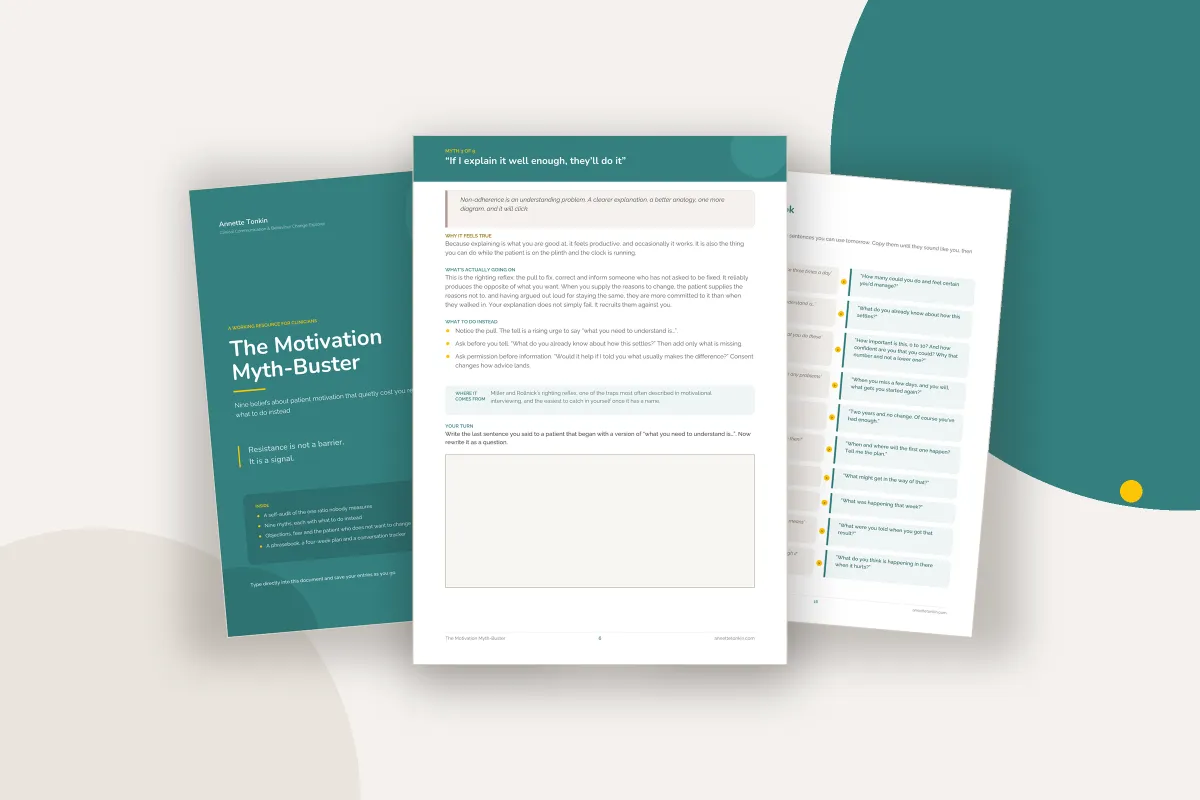
The Motivation Myth-Buster
Nine beliefs about patient motivation that sound sensible, and quitly cost you results. A 19-page working PDF you can type straight into.
Changing Beliefs
7 Steps to Help Minds Change: A Practical Guide for Allied Health Clincians
BROWSE
Why do patients cling to beliefs like "exercise will make my pain worse"?
Based on David McRaney's How Minds Change, this guide reveals that beliefs are tied to identity and past experiences—facts alone trigger defensiveness.
You'll learn a 7-step framework for creating conditions where patients question their own thinking.
Use techniques like the confidence rating ("On a scale of 1-100, how confident are you? Why didn't you pick a higher number?") to help patients convince themselves.
Includes real clinical scenarios, specific phrases, and reflection questions to connect treatment to their core values.
Objections and Resistance
How to Navigate Objections with Confidence
BROWSE
What to do when a patient says 'no'.
"I can't afford it." "I don't have time." "I'll think about it."
The first objection is rarely the real one. It's the polite version, the one that ends the conversation without either of you having to go further.
C.L.A.R.C. is five steps for that moment: Connect, Label, Ask, Reflect, Collaborate.
It gives you something to do with a 'no' other than explain harder.
This is an eight-page working resource, not a summary.
There's a one-page version to pin up before a difficult conversation, a table of what the ten most common objections are usually protecting, and room to take one of your own conversations apart and run it again.
Type into it on screen, or print it and use a pen.
When Patients Say "But I Read Online That..."
Turn 'Dr Google' Moments into Collaborative Partnerships
BROWSE
Your patient says "I'm pretty sure I have a torn rotator cuff—I looked up all the symptoms."
Your appointment just became a debate.
In reality, patients who arrive "armed with information" aren't trying to undermine you—they're anxious, they've been dismissed before, or they want to be involved.
This guide gives you the R.E.S.P.E.C.T. framework to channel their research into partnership.
Learn the exact phrase that diffuses defensiveness: "I can see you've done thorough research—what stands out to you?"
Then listen, validate, and bridge to your expertise without triggering resistance.
Includes real scenarios, strategies for different personalities (anxious, sceptical, highly informed), and ready-to-use phrases for your next consultation.
Adherence and Follow-Through
7 Steps to Creating a Treatment Plan Your Patient Will Fol1low
BROWSE
You create the perfect plan. Two weeks later, they've done almost nothing. Sound familiar?
Treatment plans fail not because patients don't care, but because we designed them FOR patients instead of WITH them.
This 7-step Well-Formed Outcome framework transforms your approach—from prescription to partnership.
Learn specific questions for each step: "What do you want to be able to do?" (positive framing), "How will this fit with your family routine?" (the ecology check that prevents self-sabotage), and "What's the first thing you'll do today?"
Includes a complete clinical scenario showing all 7 steps in action plus a quick reference guide. Stop wasting brilliant clinical advice on plans patients abandon.
Instant Influence Questions
6 Questions to Help the Patient Talk Themselves into change
BROWSE
Your patient says "I don't think I can do that."
Adding more facts or pressure only creates more resistance.
What if your patients already have motivation—they just need help finding it.
This guide gives you Michael Pantalon's six-question method adapted for allied health.
The game-changer: when a patient rates readiness as "4," ask "Why didn't you pick a lower number?"
This makes them articulate their existing motivation instead of defending their resistance.
Includes a complete clinical scenario and quick reference card for immediate use.
Language Strategies for Effective Communication
A Quick Reference Guide For Clinicians
BROWSE
You can do everything right clinically — and still walk out of a consult wondering what just happened.
Most of the time, it's not what you said.
It's the conversation you were in versus the conversation your patient actually needed.
This free guide introduces three distinct conversation types that show up in every clinical encounter — and gives you a simple tool to diagnose which one you're in before you respond.
One pause. One question. A completely different outcome.
The Influence of "Why": A Quick Reference
Understanding When "Why" Builds Trust and When It Triggers Defensiveness
BROWSE
"Why haven't you been doing your exercises?"
Your patient's shoulders tense. Eyes drop. Energy shifts.
The conversation just became harder.
"Why" is one of the most powerful words in clinical communication—and the most dangerous.
Used poorly, it feels accusatory and triggers defence. Used wisely, it reveals values and uncovers motivation.
This guide helps you wield "why" with care.
You'll learn which "why" questions build trust versus create resistance, practical alternatives that invite exploration, real clinical scenarios, and a quick reference table for in-the-moment decisions.
Asking "why" isn't the problem.
Asking the wrong "why" is.
Taming Willpower
Practical Strategies to Support Patient Adherence Without
BROWSE
Your patient nods enthusiastically, promises to do their exercises daily.
Two weeks later: "I meant to do them, I just... couldn't stick with it."
Sound familiar?
Willpower isn't the problem. Relying on willpower is.
This guide shows you how to help patients build adherence systems that don't require willpower.
You'll discover the everyday activities that drain willpower reserves, four evidence-based strategies (habit stacking, environmental modifications, tiny experiments, and pre-commitment), and real clinical scenarios showing these approaches in action.
Your patients don't need more willpower. They need better systems.
Are You in the Right Conversation
How understanding conversation types transforms your patient relationships
BROWSE
You can do everything right clinically — and still walk out of a consult wondering what just happened.
Most of the time, it's not what you said.
It's the conversation you were in versus the conversation your patient actually needed.
This free guide introduces three distinct conversation types that show up in every clinical encounter — and gives you a simple tool to diagnose which one you're in before you respond.
One pause. One question. A completely different outcome.
New resources added regularly.
A Guiding Question
“From my experience and what we know from the latest research, this approach might work well for you. Where can you see integration with what you’re already doing?”
Want updates when new insights are published? Check back regularly or sign up here for a free guide:
A Guiding Question
“From my experience and what we know from the latest research, this approach might work well for you. Where can you see integration with what you’re already doing?”
Want updates when new insights are published? Check back regularly or sign up here for a free guide:
Invitation to Go Deeper
These ideas are a starting point. Ready for live application?
For Clinics & Teams
Workshops for teams: Build skills in frameworks like C.L.E.A.N. and R.E.S.P.E.C.T. to handle resistance, boost adherence, and reduce cancellations.
For Individual Clinicians
1:1 Coaching for clinicians: Master conversations that transform frustration into confident action.
Invitation to Go Deeper
These ideas are a starting point. Ready for live application?
For Clinics & Teams
Workshops for teams: Build skills in frameworks like C.L.E.A.N. and R.E.S.P.E.C.T. to handle resistance, boost adherence, and reduce cancellations.
For Individual Clinicians
1:1 Coaching for clinicians: Master conversations that transform frustration into confident action.

Driving adherence and clinical outcomes


Get In Touch
Location: 26 Akala Street , Flaxton Queensland 4560
Phone: 0417 817 388
Email: [email protected]