Statement-Style Questions: The Communication Shift That Reduces Patient Defensiveness
You've explained the home exercises three times. Your patient nods, gives you that glazed look and you know—absolutely know—they're not going to do them.
So you ask again: "What's stopping you from doing these?"
And just like that, the conversation goes nowhere.
Here's what's actually happening: Your question just triggered their defences. Not because you said something wrong, but because direct questions—the kind we were all taught to ask—often create pressure instead of opening dialogue.
The same thing happens with your team. You ask a staff member, "How do you plan to improve your punctuality?" and watch them mentally retreat behind excuses and justifications.
But there's another way. A communication technique that gathers the same information without triggering defensiveness. It's not about asking better questions—it's about learning when to stop asking questions altogether.
Why Traditional Questions Create Resistance
We've been trained to ask direct questions. "What challenges are you facing?" "How will you make time for this?" "Why haven't you been following through?"
These questions seem perfectly reasonable. They're clear, focused, and should lead to productive dialogue.
Except they don't.
Direct questions create what researchers call cognitive overload. When someone feels questioned, their brain shifts into defensive mode—searching for acceptable answers rather than engaging in honest reflection.
Dr. Amishi Jha's work on attention demonstrates that pressure and perceived judgement diminish our capacity to process information effectively. We focus on self-protection, not problem-solving.
In clinical settings, this means patients tell you what they think you want to hear. Staff members become guarded instead of collaborative. And you're left wondering why conversations that should move forward keep circling back to the same stuck places.
Resistance isn't always a patient problem. Sometimes it's a communication problem.
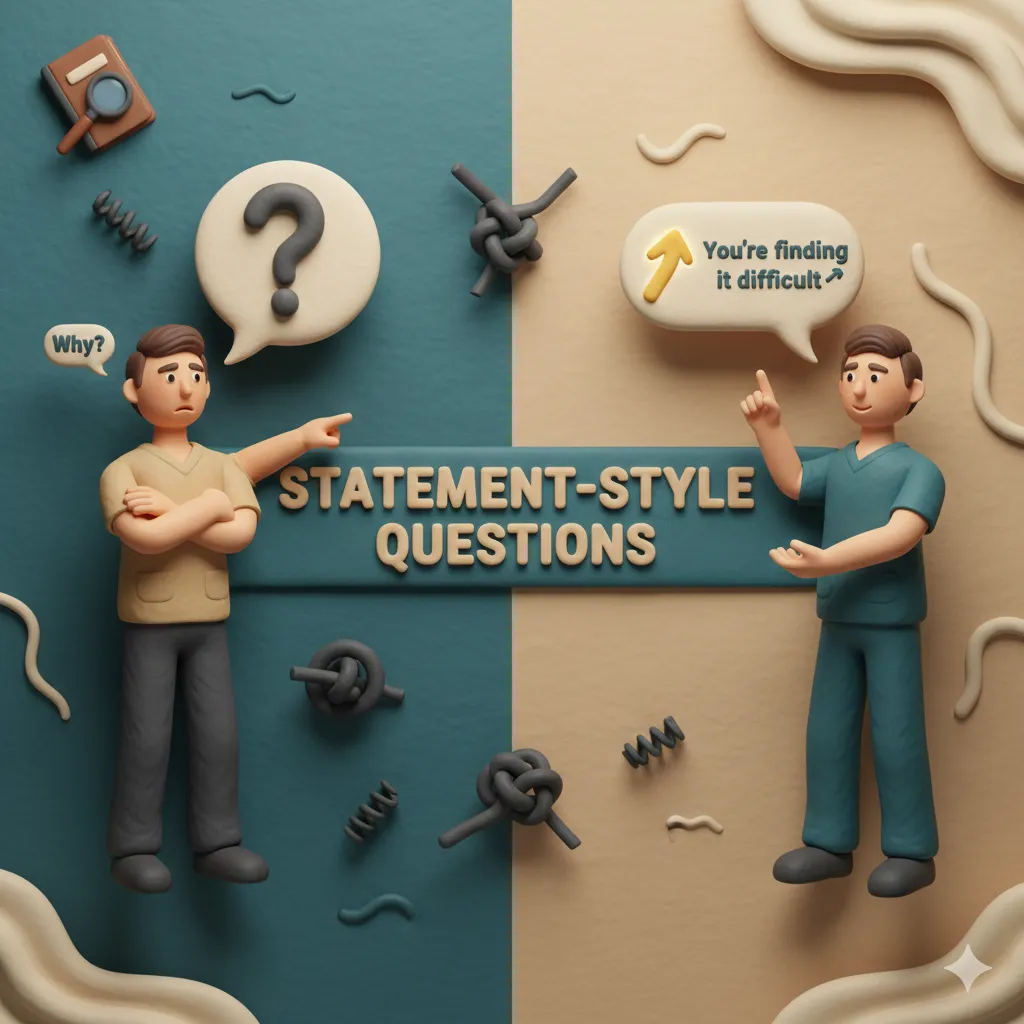
The Art of Statement-Style Questions
This is where the skill—the art—comes in.
Instead of asking questions, you make gentle observations. You use inflection to transform statements into invitations for dialogue. A slight upward lift at the end of your sentence (↗) creates all the space of a question without any of the pressure.
It's subtle. It's powerful. And it requires practice to master.
Traditional question:
"What's preventing you from doing your exercises?"
Statement-style question:
"It sounds like something's getting in the way of the exercises↗"
See the difference? The first feels like interrogation. The second feels like understanding.
Traditional question:
"How do you plan to improve your time management?"
Statement-style question:
"You're looking for ways to manage your time better↗"
One creates pressure to justify. The other invites collaboration.
Inflection: Your Technical Tool
The mechanics matter here. Inflection is what transforms your statement into a question without requiring the word order or tone of traditional questioning.
Upward inflection (↗) signals curiosity and invitation:
"You're finding it difficult to fit these in↗"
"This approach isn't quite working for you↗"
Flat or downward inflection (→) makes an observation:
"You're committed to getting better."
"This team works well together."
The beauty of this technique lies in its subtlety. You're not interrogating. You're not testing. You're simply making an observation that happens to invite response—if they choose to give it.
This is the artistry: knowing which inflection to use, when to pause, how to create space for honest dialogue rather than defensive justification.
Tone: The Emotional Message Beneath Your Words
Inflection provides the technical framework, but tone carries the emotional weight.
Your tone tells people whether you're genuinely curious or gathering ammunition for judgement. And people always—always—pick up on that difference, even if they can't articulate it.
Warmth creates safety
A warm tone signals genuine interest and invites openness. Clinical detachment has its place, but when you need connection and honesty, warmth wins.
Compare these:
Warm: "It seems like (label) you're having some concerns about this treatment↗"
Detached: "You have concerns about this treatment↗"
Same words. Entirely different emotional message.
Pace removes pressure
Slowing down your speech creates breathing room. Rapid-fire questions feel like interrogation. Thoughtful pacing with strategic pauses gives people space to think rather than react.
Volume signals safety
When discussing sensitive topics—non-adherence, performance issues, treatment resistance—lowering your volume slightly can reduce defensiveness. Softer doesn't mean weak. It means safe.
Curiosity trumps interrogation
The difference between curious and interrogative tone is subtle but unmistakable:
Curious: "You're not convinced this is the right approach for you↗"
Interrogative: "You don't think this approach will work↗"
One invites. One challenges. Your patients and colleagues feel the difference instantly.
Clinical Applications: Turning Resistance Into Dialogue
With Patients
Treatment hesitation
Instead of: "Why won't you try this treatment?"
Try: "This treatment doesn't feel right for you↗"
You've just acknowledged their perspective without challenging it. Watch how often this leads to genuine conversation about their actual concerns.
Non-adherence
Instead of: "What's stopping you from doing your exercises?"
Try: "Something's making it hard to keep up with the exercises↗"
No guilt. No pressure. Just an invitation to share what's actually happening.
Cost or time concerns
Instead of: "How important is your health to you?"
Try: "The investment feels significant right now↗"
You've validated their concern and opened space for exploring options rather than defending your recommendations.
Progress conversations
Instead of: "How do you think you're progressing?"
Try: "You're noticing some changes↗" or "Progress feels slow to you↗"
Both gather their perspective without putting them on the spot to perform or justify.
With Your Team
Performance discussions
Instead of: "What's causing your lateness?"
Try: "Something's making mornings challenging for you↗"
No judgement. No excuse-making. Just problem-solving.
Navigating change
Instead of: "How do you feel about the new protocols?"
Try: "These new protocols feel like a big shift↗"
You're acknowledging reality without forcing immediate buy-in or false enthusiasm.
Delegation and accountability
Instead of: "When will you have this completed?"
Try: "You're working through the timeline for this↗"
Space for honest communication about realistic expectations, not pressure to over-promise.
Team dynamics
Instead of: "What's the problem between you and Sarah?"
Try: "Working with Sarah feels challenging right now↗"
Honest dialogue becomes possible when you're not forcing someone to label a colleague as "the problem."
Developing the Skill
This technique isn't manipulation. It's creating psychological safety that allows for honest, productive dialogue.
Start with one conversation type—perhaps discussing exercise adherence with patients. Practice for a week. Pay attention to:
Your inflection patterns
The warmth in your tone
How people respond differently
You'll likely notice something unexpected: when people don't feel defensive, they share more, not less. The information you need flows more easily because you've stopped blocking it with interrogation.
From Frustration to Curiosity
At its core, this technique embodies a principle that transforms clinical communication: replace frustration with curiosity.
When you approach conversations with genuine curiosity rather than judgement, your tone naturally softens. Your inflection becomes more inviting. Your relationships become more collaborative.
Communication isn't a soft skill. It's a results skill.
The way you frame your observations directly impacts treatment adherence, staff engagement and the outcomes you achieve together. When you master the art of statement-style questions—knowing when to make an observation instead of asking a question, when to use that upward inflection, how to convey curiosity through tone—you transform stuck conversations into collaborative problem-solving.
This is the human side of healthcare that clinical training never covered. But it's the side that often determines whether your brilliant clinical skills actually lead to better outcomes.
Practice Makes Artistry
The next time you're facing a resistant patient or a defensive team member, try this: Replace your question with an observation. Add that slight upward inflection. Notice what changes.
This is the art of clinical communication—knowing when to stop asking and start observing. It's a skill that transforms resistance into dialogue, frustration into curiosity, and stuck conversations into collaborative problem-solving.
And like any art form, it gets better with practice.
Two Ways to Continue This Journey
The insights in this article are just the beginning. If you're ready to develop these skills more deeply:
1. Join my fortnightly newsletter
Receive practical communication strategies, real patient scenarios, and evidence-based tools delivered straight to your inbox. Every fortnight, I share what's working in real clinical practice—no theory without application, no generic advice.
Click on any of the useful downloads and it will add you to my newsletter and I'm hoping you will have a useful reference too
2. Let's talk about working together
Whether you're interested in one-to-one coaching, team workshops, or developing communication strategies for your clinic, I'd love to explore how I can support your growth.
Communication isn't a soft skill—it's a results skill. And you don't have to master it alone.
I am a Clinical Communication & Behaviour Change Explorer with over 30 years of experience helping Allied Health Clinicians master the human side of healthcare. Through coaching, workshops, and practical frameworks, she helps experienced practitioners turn resistance into engagement and frustration into confident action.