
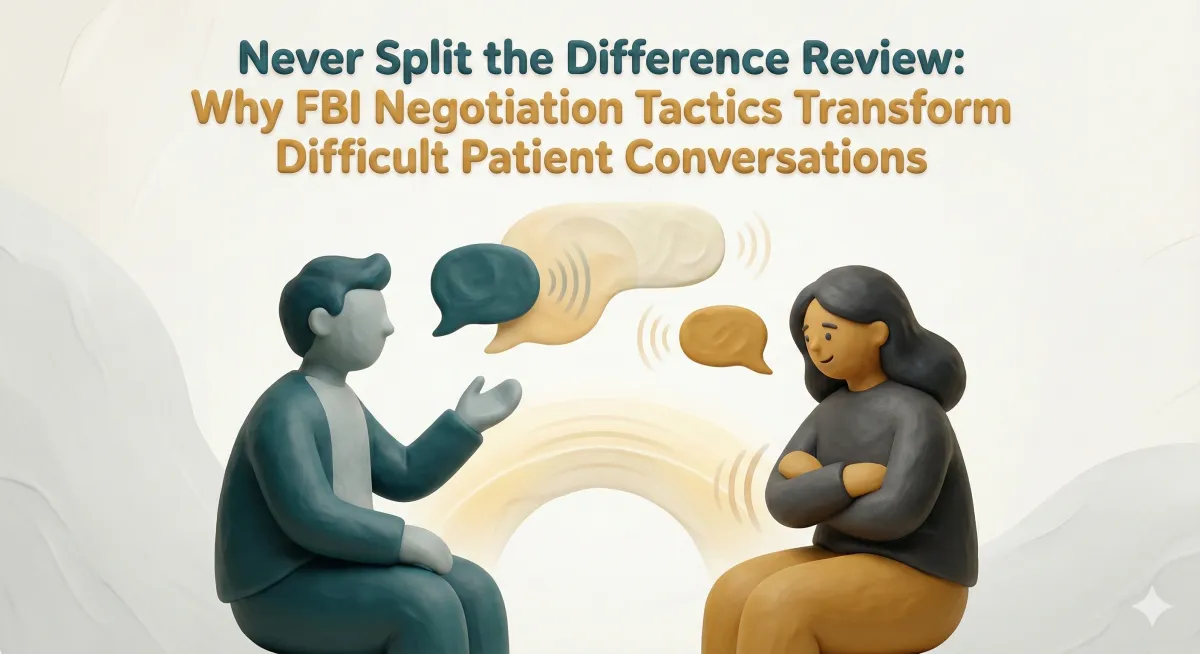
Never Split the Difference Review: Why FBI Negotiation Tactics Transform Difficult Patient Conversations
Your patient sits across from you, arms crossed, jaw tight. "I've tried physio before. It didn't work."
You feel the familiar defensiveness rising—the urge to explain why this time will be different, why your approach is better, why they need to trust you. But the more you push, the more they pull away.
What if the problem isn't what you're saying, but how you're trying to convince them?
Why This Book Matters for Clinicians
Chris Voss's Never Split the Difference brings the high-stakes world of FBI hostage negotiation into your treatment room—and the translation is more relevant than you might expect.
Voss, former lead international kidnapping negotiator for the FBI, teaches tactical empathy, strategic questioning, and emotional calibration techniques that work when the stakes are literally life and death.
For allied health clinicians, this book addresses a critical gap: you're trained to assess bodies and prescribe treatments, but rarely taught how to navigate the emotional resistance, skepticism, and fear that derail even your best clinical plans.
When a patient says "I don't have time" or "I've tried everything," they're not giving you information—they're negotiating. And most clinicians don't recognise the conversation for what it is.
Voss's frameworks help you defuse defensiveness, build rapid trust, and guide patients toward decisions they feel good about—without manipulation, without pressure, and often without them realising you've influenced the outcome at all.
Tactical Empathy Isn't Sympathy—It's Strategy
Voss draws a sharp distinction that transforms clinical communication: empathy isn't about being nice or agreeing with someone.
Tactical empathy is about demonstrating that you understand their perspective so thoroughly that their defensiveness drops and their thinking becomes clearer.
He teaches a technique called "labelling"—naming the emotion you're observing without judgment: "It sounds like you're frustrated that previous treatment hasn't worked" or "It seems like you're worried this will take too much time." These aren't questions requiring answers. They're mirrors that show patients you see them.
In clinical practice, this means: When your patient arrives late, cancels frequently, or resists recommendations, your first move isn't to educate or persuade—it's to label what you're observing. "It seems like something about this treatment plan doesn't feel manageable for you right now." Then pause. Let them fill the silence.
Why it matters: Defensiveness is the enemy of behaviour change. When patients feel misunderstood or judged, their primitive brain takes over and rational conversation becomes impossible.
Labelling defuses that threat response faster than any amount of logical explanation. You're not agreeing with their reasons—you're showing you understand their emotions.
That creates space for real conversation.
"No" Is More Powerful Than "Yes"
This might be Voss's most counterintuitive insight: getting someone to say "yes" early in a conversation creates psychological pressure and triggers skepticism.
But getting them to say "no" makes them feel safe and in control.
Voss calls this giving people "permission to say no"—and it paradoxically makes them more likely to engage. When you ask "Is now a bad time?" instead of "Is now a good time?", you're inviting honest pushback rather than polite compliance.
When you say "You're probably going to think this exercise is too difficult" rather than "This exercise will be perfect for you," you remove the pressure to agree.
In clinical practice, this means: Stop framing recommendations as questions that require "yes." Instead, invite disagreement: "Is there any reason this wouldn't work for your schedule?" or "Have I missed something about what would make this difficult?"
You're creating psychological safety for honest objection—which gives you real information to work with instead of false agreement followed by non-adherence.
Why it matters: Every clinician has had the patient who enthusiastically agrees to everything, then never follows through.
That's not resistance—that's premature "yes" without genuine commitment.
When you give patients permission to say "no," to voice concerns, to identify obstacles, you're building authentic agreement rather than polite compliance. Real "yes" only happens after obstacles are addressed, not before.
Calibrated Questions Guide Without Pushing
Voss introduces "calibrated questions"—open-ended questions beginning with "what" or "how" that shift the burden of problem-solving to the other person without them feeling interrogated.
These aren't information-gathering questions; they're influence tools disguised as curiosity.
"How am I supposed to do that?" sounds confrontational, but "What about this feels challenging?" invites collaboration.
"Why won't you do your exercises?" triggers defensiveness, but "What would need to change for this to feel more doable?" creates partnership.
The genius of calibrated questions is they force the other person to think through solutions whilst feeling completely in control of the conversation.
They can't simply say "no" to a "how" or “what” question—they have to engage with the problem.
In clinical practice, this means: When patients resist your recommendations, resist the urge to problem-solve for them.
Instead ask: "What concerns you most about trying this?" or "How would this need to work to fit your life?" You're inviting them into the solution rather than imposing your solution on them.
Why it matters: Patients don't resist their own ideas—they resist yours.
When you use calibrated questions effectively, patients talk themselves into behaviour change whilst believing it was entirely their decision.
That's not manipulation; that's recognising that sustainable change requires internal motivation, not external pressure. Your job isn't to convince—it's to guide their thinking until they convince themselves.
Mirroring Creates Connection Without Agreement
One of Voss's simplest but most powerful techniques is mirroring—repeating the last few words someone said, often as a question, then staying silent.
It sounds absurdly simple, but it works because it signals you're listening deeply and invites elaboration without the pressure of direct questioning.
Patient: "I just don't have time for exercises."
Clinician: "Don't have time?"
Patient: "Well, I mean, mornings are chaos with the kids, and by evening I'm exhausted..."
You've just learned the real obstacle (morning chaos and evening fatigue) without interrogating or problem-solving prematurely. The patient keeps talking because mirroring creates a gentle pull toward deeper disclosure.
In clinical practice, this means: When patients make vague objections ("It's too hard," "I can't," "It won't work"), don't immediately offer solutions or reassurances.
Mirror their key words back to them and wait. They'll almost always elaborate, giving you the real information underneath the surface statement.
Why it matters: Most clinical conversations move too fast. We hear an objection and immediately jump to fixing it, often solving the wrong problem because we never discovered what the patient actually meant.
Mirroring slows the conversation down and creates space for truth. It's uncomfortable at first—the silence feels awkward—but it consistently reveals information that direct questioning misses.
The Challenge
This book is highly readable, filled with gripping stories, and immediately applicable—but it comes with two significant challenges for clinicians.
First, Voss is teaching negotiation, not therapy. His context is fundamentally adversarial (hostage situations, business deals) where there are clear winners and losers. Clinical relationships aren't adversarial—you and your patient share the same goal of their wellbeing.
You'll need to translate his techniques through a lens of genuine collaboration, not strategic manipulation.
Second, these techniques feel manipulative at first, even when used ethically. When you start labelling emotions, using calibrated questions, and mirroring strategically, it can feel calculated rather than authentic.
You're suddenly hyper-aware of your language choices in a way that makes natural conversation feel impossible.
The discomfort is temporary. Like any new skill, tactical empathy feels mechanical until it becomes intuitive. But you need to push through that awkward phase where you're thinking too much about technique and not enough about genuine curiosity.
The goal isn't to become a master manipulator—it's to internalise these patterns until they enhance rather than replace authentic connection.
Where This Connects to My Work
Voss's tactical empathy and calibrated questions are the foundation of what I teach through the C.L.E.A.N. framework—particularly the "Listen" and "Acknowledge" components.
When clinicians come to me frustrated by patient resistance, they're usually making the same mistake: they're trying to convince rather than understand.
Labelling is precisely what I mean when I talk about validating before exploring. You can't influence someone who feels misunderstood. Voss gives you the specific language patterns to demonstrate understanding so thoroughly that defensiveness dissolves.
His emphasis on "no-oriented questions" mirrors my teaching about reducing patient pressure.
When you invite disagreement ("Is there any reason this wouldn't work?"), you're not being pessimistic—you're creating psychological safety for honest conversation. Real commitment only happens when patients feel free to voice doubts without judgment.
The difference between a clinician who says "You need to do these exercises daily" and one who asks "What would need to change for daily exercises to feel manageable?" isn't just politeness.
It's strategic use of calibrated questions to shift from prescription to collaboration—and it fundamentally changes patient engagement.
Bottom Line Recommendation
This book is for: Clinicians who struggle with defensive, skeptical, or "difficult" patients and want specific techniques to navigate high-emotion conversations. If you're tired of logical explanations falling flat and want to understand the psychology of influence, Voss delivers practical tools you can use immediately.
This book isn't for: Clinicians who want gentle, therapy-focused communication training. Voss's tone is confident, occasionally brash, and unapologetically strategic. If you're uncomfortable with the idea that clinical conversations involve influence and persuasion, this book will feel too manipulative.
One immediate action: Tomorrow, when a patient raises an objection or concern, resist your urge to immediately problem-solve or reassure. Instead, label what you're hearing: "It sounds like you're worried this won't fit your schedule" or "It seems like you're skeptical this will work." Then pause. Count to five in your head and let them fill the silence. Notice what you learn that you would have missed by jumping straight to solutions.
Book Details:
Never Split the Difference: Negotiating As If Your Life Depended On It
Author: Chris Voss with Tahl Raz
Published: 2016
Length: 288 pages
Want help developing these skills in your practice? I offer personalised coaching for experienced clinicians who want to transform patient resistance into engagement. Contact me to explore how communication coaching could change your clinical outcomes.
Communication isn't a soft skill—it's a results skill. And you don't have to master it alone.
I am a Clinical Communication & Behaviour Change Explorer with over 30 years of experience helping Allied Health Clinicians master the human side of healthcare. Through coaching, workshops, and practical frameworks, she helps experienced practitioners turn resistance into engagement and frustration into confident action.