
Stop Rescuing: How Senior Clinicians Accidentally Create Dependent Juniors
The Mentor's Shift, Part 2 of 4
It is the fifth time this month that the same junior has knocked on your door.
Not the same problem. A different case each time, and each one a fair question. But somewhere around the fifth knock, a quiet thought arrives that you feel slightly guilty for having.
Why does someone with their training still need me for this?
You push it away, because they are keen and capable and you like them. But it lingers, because it is pointing at something real. A clinician should be growing more independent over time, not less. Instead, the questions are getting more frequent, not harder.
Here is the part that is genuinely uncomfortable. The dependence you are noticing is not really about them. It is something you have been building, one helpful answer at a time, without ever deciding to.
Dependence is built, not chosen
No one sets out to make a junior dependent. That is what makes it so easy to do.
Every individual rescue is small, reasonable and kind. They are stuck, you are not, so you help. Nothing about any single instance looks like a problem. The problem only exists in the accumulation, and accumulation is invisible in the moment.
This is the trap of mentoring by good intentions. Each answer you give is defensible on its own. It is only when you step back and see the fifth knock, the growing frequency, the capable clinician who still cannot quite move without you, that the pattern becomes visible. And by then it is a habit, theirs and yours, worn smooth by repetition.
So the dependence is not something the junior asked for or you intended. It is an emergent property of a hundred kind moments. Which means you cannot fix it by being kinder. You fix it by changing what kindness looks like.
The two kinds of kindness
There is a difference between helping someone and rescuing them, and it is easy to miss, because both feel kind in the moment. They are not the same kindness, and they do not produce the same clinician.
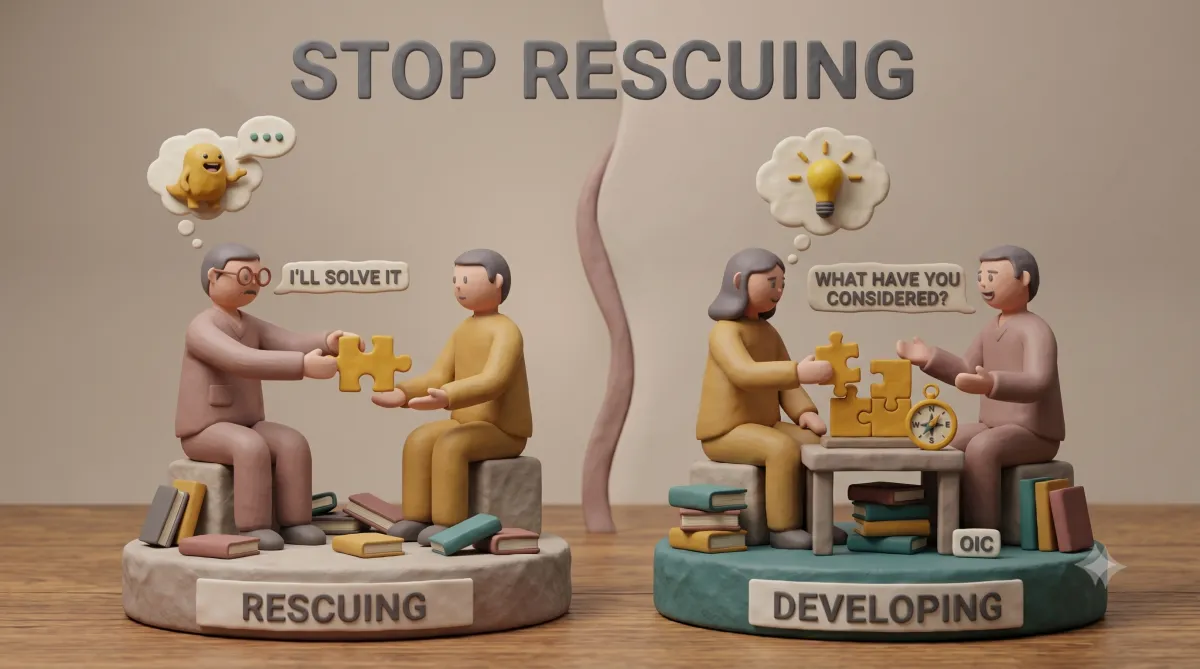
Rescuing removes the difficulty. You supply the answer, smooth the path, take the problem off their hands. The relief is immediate and mutual, but the learning belongs to you, not them. You did the reasoning. They watched.
The other kind of kindness is harder, and it does not feel kind at all while you are doing it. It is leaving the difficulty with them a little longer than is comfortable, so that the thinking happens in their head rather than yours. It looks, from the outside and sometimes from the inside, almost like withholding. It is the opposite. It is the only version that builds a clinician who can stand on their own.
Carl Rogers spent a career arguing that people carry within them a substantial capacity to work things out, and that the helper's real task is to create the conditions for that capacity to operate, not to override it with their own. Every rescue, however warm, quietly overrides it. It says, in effect, your thinking is not quite enough, let me. The harder kindness trusts that it is enough, and proves it to the one person who most needs convinced: the junior themselves.
The real skill is tolerating discomfort
If the answer is simply to rescue less, why is it so hard? Because the thing standing in your way is not a lack of technique. It is a feeling.
Watch what happens in your own body when a junior struggles in front of you. The answer is right there, and they are reaching for it, slowly, imperfectly, sometimes painfully. And it is genuinely uncomfortable to watch. There is a pull, almost physical, to end the struggle and put them out of their difficulty. Silence feels like a failure to help. Knowing the answer and not giving it feels almost unkind.
That discomfort is the whole game. Not the question you ask, not the clever technique, but your capacity to sit inside that pull and not act on it. Mentoring, at the moment that matters, is a discomfort-tolerance skill before it is a communication skill.
And here is what is worth understanding about the discomfort. It is not a signal that you are doing harm. It is a signal that learning is happening. The struggle you are watching, the halting, effortful reach for the answer, is the exact process by which reasoning gets built. If you remove it, you remove the learning along with it. The discomfort you feel is the felt sense of someone growing, and your instinct misreads it as a problem to solve.
So the move is not to make the discomfort go away. It is to recognise it for what it is, and let it sit there. When you feel that urgent pull to rescue, that is precisely the moment to do nothing for one more breath. The struggle is not a failure of your mentoring. It is your mentoring.
What to do instead of rescuing
Tolerating the discomfort buys you a few seconds. Here is what to put in them.
Hand the struggle back as a question. When a junior brings you a problem, the most useful first move is almost always to return it. "What have you considered so far?" or "What is making this one feel difficult?" The point is not to test them. It is to keep the thinking where it belongs, in their head, and to signal that you expect them to have some. A real question invites reasoning. "Have you thought about trying X?" is just advice wearing a question mark, and they can tell the difference instantly.
Then protect the silence that follows. Nancy Kline (Time to Think) observed that the quality of a person's thinking depends enormously on the quality of attention they receive while they do it. Most juniors are interrupted before they have finished a sentence, let alone a thought. So once you have asked, the discomfort returns, because now there is silence, and silence is the hardest thing of all to leave alone. Leave it alone. That silence is where the reasoning happens. Hold your attention on them, keep your mouth closed, and let them reach the end of their own thought. You will be surprised how often they arrive somewhere sensible without you, and when they do, the confidence is theirs to keep.
Notice that both moves ask the same thing of you. Not cleverness. Tolerance. The willingness to stay in an uncomfortable moment a few seconds longer than feels natural.
You are not abandoning them
It is worth being clear about what this is not, because the fear of rescuing too little is real.
Refusing to rescue does not mean leaving a junior to flounder indefinitely, or withholding knowledge they genuinely need, or watching them head toward a clinical error in the name of their development. Patient safety is never the place to practise restraint. If they are stuck for real, you step in. If it matters clinically, you tell them.
The discipline is about the ordinary case, the one where they could get there with a little time and a little discomfort, and you short-circuit it out of habit or hurry. That is where the rescuing does its quiet damage. You are not choosing between helping and not helping. You are choosing between the help that solves today's problem and the help that builds the clinician who solves the next one alone.
What changes when you stop rescuing
The first few times, it will feel slower and slightly awkward. You are unlearning a reflex built over a career, and the junior may even look mildly thrown that you have not simply told them.
Stay with it. Within a few conversations, something shifts.
They start arriving with their reasoning already half-formed, because they have learned you will ask for it. They interrupt you less, because they trust themselves more. And the questions that do reach your door become better ones, the genuinely hard cases rather than the ones they could have worked out alone.
That is the goal of mentoring, and it is the opposite of what rescuing produces. Not a clinician who keeps knocking, but one who increasingly does not need to.
Try this, this fortnight
Pick one junior and one conversation. You do not need to overhaul how you mentor. You need one rep, aimed squarely at the discomfort.
The next time they bring you a problem and the answer is sitting right there, ready to go, do three things in order:
Notice the pull. The moment you feel that urgent need to end their struggle and supply the answer, name it to yourself. That feeling is the thing to resist, not obey.
Hand it back as a question before you offer anything. "What have you considered so far?" works almost every time.
Sit in the silence that follows long enough for them to finish the thought. Count to five in your head if you have to. That silence is where the learning lives.
Then notice what they reach on their own.
That is the whole practice. One junior, one tolerated discomfort, one held silence. Do it a few times and you will start to see who has been waiting for permission to think.
In the next post in this series, we will look at the move that builds on this one: shifting from giving feedback to growing reflection, so that your clinicians learn to assess their own work rather than waiting for you to assess it for them.
Books referenced in this article
On Becoming a Person - Carl Rogers
Time to Think - Nancy Kline
If this is the kind of thinking you want to bring into your practice or your team, explore how I work with clinicians and clinics here: https://annettetonkin.com/program-structure-and-participation
Annette Tonkin helps experienced clinicians become more skilful, intentional mentors through her Mentoring Mastery work. If developing thinking rather than dependence is something you want to do more deliberately, you can find out more about Mentoring Mastery.