
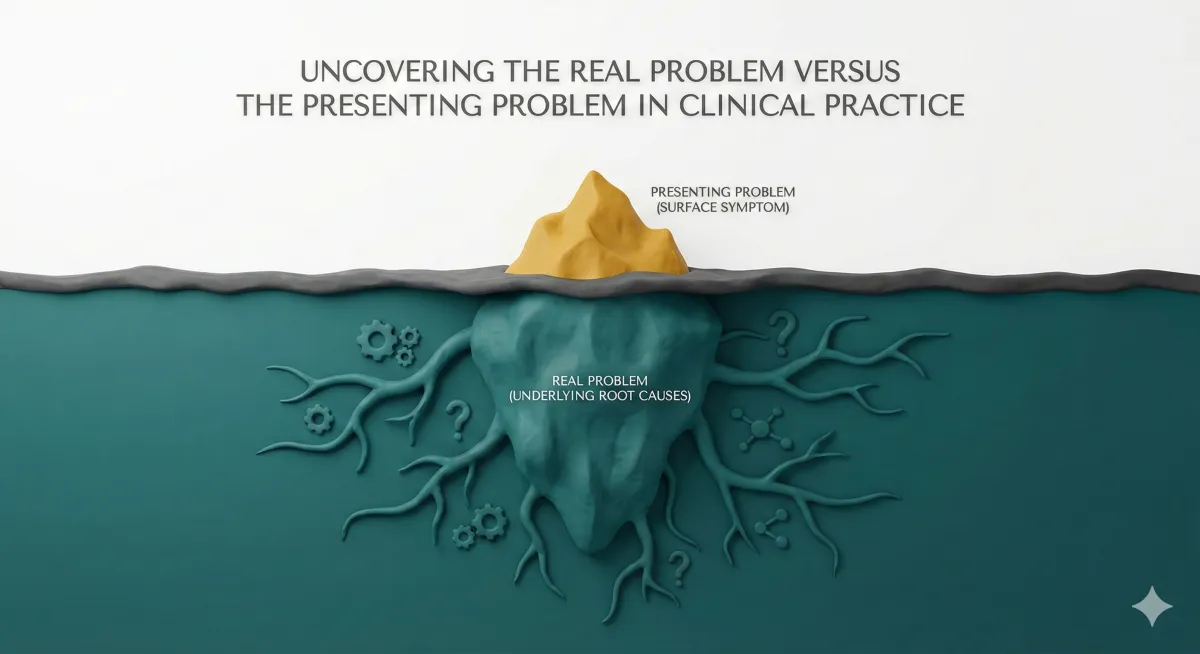
Uncovering the Real Problem vs the Presenting Problem in Clinical Practice
An allied health clinician is working with David, a 52-year-old client who presents with ongoing fatigue that's affecting his work performance. During the initial consultation, David explains he's been tired for months and wants help "getting his energy back."
The clinician begins discussing sleep hygiene and activity pacing strategies. They talk about gradual exposure to activity, rest breaks during the workday and monitoring energy levels throughout the week.
David nods along. He agrees to try the suggestions. He books his follow-up appointment.
But what the clinician hasn't uncovered yet: David's fatigue started six months ago when his adult daughter moved back home following a difficult divorce.
His mother was diagnosed with dementia around the same time. He's been lying awake at 3am worrying about how he'll manage both situations financially and emotionally. His body feels heavy because his nervous system is overwhelmed.
The fatigue isn't the problem—it's the symptom of an unprocessed stress response that has nowhere to go.
And unless the clinician digs deeper, they'll spend the next six sessions treating a symptom whilst the real problem remains untouched.
Why We Stop at the Surface
Michael Bungay Stanier writes in The Coaching Habit: "Focus on the real problem, not the first problem."
Simple advice. Difficult execution.
Most clinicians stop at the presenting problem not because they lack skill, but because they lack permission—from themselves, from their training and sometimes from the time constraints of their workplace.
We're trained to assess, diagnose and intervene. We're taught to take what patients tell us and translate it into treatable conditions. Fatigue becomes “de-conditioning" or "poor sleep hygiene." Pain becomes "muscle tension" or "postural dysfunction."
This reductionist approach works beautifully for acute, biomechanical problems. Sprained ankle? Rolled knee? Acute back strain? Assess, treat, monitor, discharge. Clean.
But chronic presentations—fatigue, overwhelm, loss of hope, persistent pain, recurring injuries, "unexplained" symptoms—rarely fit this model. Because the body isn't just responding to physical demands. It's responding to life.
Stephen Porges's Polyvagal Theory helps explain what's happening with David. His nervous system is stuck in a chronic state of sympathetic activation—fight or flight mode that never quite switches off.
His HPA axis (hypothalamic-pituitary-adrenal axis) is dysregulated from months of unrelenting stress. His body is producing cortisol at inappropriate times, his sleep architecture is disrupted and his inflammatory markers are likely elevated.
The fatigue isn't laziness or poor conditioning. It's his nervous system trying to protect him by forcing rest.
But the clinician who stops at "let's work on your sleep and activity levels" will never discover this. Because that requires asking different questions.
The Cost of Missing the Real Problem
When you treat presenting problems without uncovering root causes, several predictable patterns emerge:
Treatment plans fail. David does his activity pacing. He tracks his sleep. He follows every recommendation. But the fatigue doesn't shift because the underlying stress response remains active. He feels like he's failing at yet another thing.
Patients become "difficult." David stops following through. He cancels appointments. He seems unmotivated. You document "poor compliance" in his notes. But he's not difficult—he's exhausted from trying interventions that don't address what's actually wrong.
Clinicians burn out. You create evidence-based treatment plans that should work. When they don't, you question your competence. You feel frustrated. You start dreading these "complex" cases. But you're not incompetent—you're trying to solve the wrong problem.
The therapeutic relationship fractures. David doesn't feel heard. You don't feel effective. Trust erodes. He doesn't return and you're relieved because the case was "going nowhere."
The tragedy is that all of this is preventable.
Not by being a better clinician in the traditional sense, but by being a better detective. By learning to ask questions that uncover context, not just symptoms.
Four Techniques for Uncovering the Real Problem
1. The Context Question
Most initial consultations follow a predictable pattern: What's the problem? How long have you had it? What makes it better or worse, etc?
These questions gather symptom data. They don't gather life data.
The Context Question shifts this by asking about timing and circumstance:
"When did the fatigue start?"
David: "About six months ago, I think."
"What else was happening in your life around that time?"
This follow-up question is critical. It assumes that symptoms don't exist in a vacuum. It positions the clinician as curious about the whole person, not just the presenting complaint.
David might pause. He might say "Nothing really" at first. That's when you wait.
Three seconds of silence.
Often, in that pause, the real story starts to emerge: "Actually, that's when my daughter moved back home..."
The timing question creates a temporal anchor. The "what else" question widens the lens to include psychosocial context. Together, they reveal patterns that symptom-focused questions miss entirely.
Research in psychoneuroimmunology demonstrates that major life stressors—relationship breakdown, caregiving responsibilities, financial strain—activate inflammatory pathways and dysregulate the autonomic nervous system.
These physiological changes manifest as fatigue, pain, digestive issues and immune dysfunction.
If you never ask about context, you'll never connect David's symptoms to their actual drivers.
2. The Impact Exploration
Presenting problems tend to be narrowly defined: "I'm tired." "My shoulder hurts." "I can't sleep.” “I can’t lose weight.”
But symptoms ripple outward. They affect work, relationships, identity and sense of future possibility.
The Impact Exploration asks about these ripple effects across different life domains:
"How is the fatigue affecting your work?"
David: "I'm struggling to concentrate. I've had to delegate projects I'd normally handle myself. I'm worried my performance reviews will suffer."
"What about at home—how's it affecting your relationships?"
David: "My wife's frustrated. She thinks I'm just being lazy. And with my daughter back home, I don't have the energy to support her emotionally like I should."
"How is this affecting your sense of yourself?"
This last question is particularly revealing. Often, chronic symptoms challenge people's core identity. David might say: "I used to be the person everyone could depend on. Now I feel like I'm failing everyone."
Notice what's happened. We've moved from "I'm tired" to a complex picture of someone whose nervous system is overwhelmed by competing demands, whose relationships are strained and whose sense of self is under threat.
This isn't just more information—it's different information. It reveals what's actually at stake for David. And it helps the clinician understand that treating the fatigue in isolation won't address the identity crisis underlying it.
Brené Brown's research on vulnerability and shame shows that when people feel their core identity is threatened, their nervous systems respond as if facing existential danger.
The fatigue isn't separate from David's fear that he's becoming someone he doesn't recognise. They're connected.
3. The Permission Bridge
David has come to you for help with fatigue. He hasn't come for therapy. He hasn't come to discuss his family situation or his financial worries.
Many clinicians sense there's more going on but don't feel they have permission to explore it. They worry about overstepping professional boundaries, seeming intrusive, or opening conversations they're not trained to manage.
The Permission Bridge addresses this explicitly:
"David, sometimes when people experience persistent fatigue like yours, it's their body's way of signalling that something bigger is going on—not just physical, but emotional or situational as well. Would you be against us exploring what else might be contributing to how you're feeling?"
This technique does several things:
Normalises the mind-body connection. You're framing this as common, not unusual. You're positioning the body as communicative, not broken.
Makes the exploration collaborative. You're asking permission rather than assuming authority. This respects David's autonomy.
Creates explicit safety. You're signalling that this conversation is part of your clinical purview, not a deviation from it.
Most patients, when given this invitation, will say yes. They're often relieved that someone is finally interested in the whole picture rather than just fixing symptoms.
And if David says no? That's valuable information too. It tells you he's not ready to explore deeper territory and you can respect that whilst staying alert for openings in future sessions.
4. The Silence After "Fine"
David might answer your context questions with surface-level responses: "Everything else is fine." "Nothing major happening." "Just the usual stress."
These are deflections, not answers. They're what people say when they haven't yet decided whether you're trustworthy enough to hear the real story.
This is where most clinicians make their mistake. They accept "fine" as final and move on.
The Silence After "Fine" technique refuses that easy exit:
Clinician: "What else was happening in your life around the time the fatigue started?"
David: "Nothing really. Everything was fine."
Clinician: [Three to five seconds of attentive silence, maintaining warm eye contact]
David: "Well... actually, that's when my daughter moved back home. And my mum was diagnosed with dementia around the same time. But that's just life, you know?"
The silence does three critical things:
It communicates that you don't believe "fine." Not in an accusatory way, but in a knowing way. You're giving David space to reconsider his deflection.
It creates room for the real answer. People need processing time. The pause allows David to access what he knows but hasn't yet verbalised.
It demonstrates you're not in a rush. Silence signals that this matters to you. That David's full story is worth waiting for.
Oscar Trimboli's research on deep listening shows that most people need to speak through three layers before reaching the truth: the superficial answer, the socially acceptable answer and finally the real answer. The silence after "fine" invites that third layer.
What This Looks Like in Practice
Let's return to David and replay the consultation:
Clinician: "Tell me about the fatigue—when did you first notice it?"
David: "About six months ago. I just haven't had any energy."
Clinician: "Six months ago. What else was happening in your life around that time?"
David: (pauses) "Nothing really. Just work and family stuff."
Clinician: [Three seconds of attentive silence]
David: "Well, my daughter moved back home after her marriage ended. And my mum was diagnosed with dementia. But everyone deals with that kind of thing, right?"
Clinician: "That's actually a lot to manage at once. How is all of that affecting you?"
David: "Honestly? I lie awake at 3am worrying about money—whether I can support my daughter financially, whether we'll need to move my mum into care, whether I'm doing enough for either of them. I feel like I'm failing everyone."
Clinician: "It sounds like your nervous system has been running on high alert for months—trying to manage multiple stressors without relief. The fatigue might be your body's way of trying to protect you by forcing rest. Would you be against us exploring the bigger picture here, not just the symptom?"
David: (shoulders drop slightly, eyes fill) "I'd really appreciate that. I've been trying to push through, but it's not working."
Notice what shifted. The clinician didn't dismiss the fatigue as a symptom. They acknowledged it as meaningful communication from David's body. They connected it to his life circumstances. And they created an invitation to address the whole system, not just one part.
This conversation took less than three minutes. But it transformed the entire treatment trajectory.
The Biopsychosocial Model in Action
What David needs isn't just activity pacing. He needs:
Psychoeducation about stress physiology—understanding that his body's response is normal, not weak.
Nervous system regulation strategies—tools to help his autonomic nervous system down-regulate.
Boundary-setting support—guidance on how to protect his energy whilst still showing up for his family.
Referral for psychological support—help processing the grief, fear and overwhelm he's carrying.
Potentially, social resources—information about caregiver support groups, financial counselling, or respite care options.
And yes, sleep hygiene and activity pacing—but now within a context that makes sense.
The biopsychosocial model, developed by George Engel in the 1970s and refined by countless researchers since, recognises that health is determined by the complex interaction of biological, psychological and social factors.
Yet many clinicians still default to purely biomedical thinking when under time pressure or when faced with complex cases.
Peter Sterling's work on allostatic load explains why. Chronic stress doesn't just create psychological discomfort—it fundamentally alters physiology.
It changes hormone regulation, immune function, cardiovascular reactivity and neural plasticity. David's fatigue is biological. But its drivers are psychosocial.
Unless you explore both, you'll keep treating the wrong problem.
David doesn't need another clinician who treats symptoms whilst missing the person.
David needs someone who understands that chronic fatigue in a 52-year-old man juggling caregiving, financial stress and relationship strain isn't a conditioning problem—it's a system under siege.
That clinician could be you.
Want to shift from lecturing to collaborating? I offer communication coaching for experienced clinicians who want to master behaviour change conversations. Contact me to explore how this work could transform your clinical practice.
Communication isn't a soft skill—it's a results skill. And you don't have to master it alone.
Further Reading and References
The Coaching Habit by Michael Bungay Stanier – Seven questions that help you uncover the real problem, not just the presenting one
The Polyvagal Theory by Stephen Porges – Understanding how the nervous system responds to threat and safety
The Body Keeps the Score by Bessel van der Kolk – How trauma and chronic stress manifest in physical symptoms
Atlas of the Heart by Brené Brown – Research on vulnerability, shame, and identity threat
How to Listen by Oscar Trimboli – The three layers of listening and why most people stop too soon
Why Zebras Don't Get Ulcers by Robert Sapolsky – The physiology of stress and why chronic activation creates disease
Engel, G. L. (1977). "The need for a new medical model: A challenge for biomedicine" – The foundational paper on the biopsychosocial approach
Sterling, P. (2012). "Allostasis: A model of predictive regulation" – How chronic stress changes physiological setpoints
I am a Clinical Communication & Behaviour Change Explorer with over 30 years of experience helping Allied Health Clinicians master the human side of healthcare. Through coaching, workshops, and practical frameworks, she helps experienced practitioners turn resistance into engagement and frustration into confident action.