
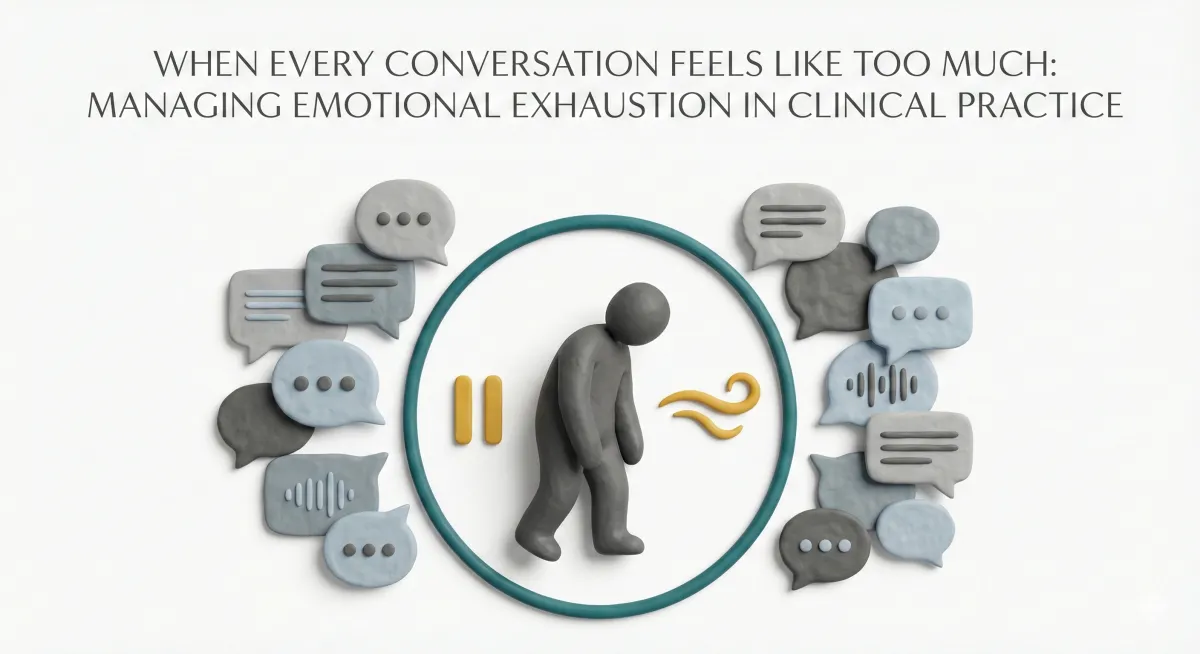
Managing emotional exhaustion in clinical practice
A mid-career physiotherapist sits in their car after a full day of appointments, feeling completely drained. Not from the physical work—they've treated complex cases before. But from everything else.
The patient who challenged their clinical reasoning in front of the waiting room.
The three conversations about why exercises matter, each met with the same polite nodding and underlying resistance.
The staff member who needs feedback but keeps getting defensive.
The schedule with a number of cancellations.
The mental load of staying calm, professional and empathetic through every interaction when what they really want is just five minutes where nobody needs anything from them.
The frustration isn't just about today—it's cumulative. Every conversation that goes nowhere. Every emotional regulation moment. Every time they've had to manage someone else's resistance, disappointment, or defensiveness while suppressing their own. And they're starting to wonder:
Is this just what the job is now? Am I losing my ability to cope? Or am I the problem?
If this sounds familiar, you're not alone. And more importantly, you're not failing.
The Hidden Cost of Clinical Communication
Emotional exhaustion from difficult conversations isn't a sign that you're doing something wrong—it's a sign that you're using an unsustainable communication approach.
You've been taught to absorb, manage and resolve every emotional dynamic in the room while suppressing your own reactions. That's not resilience—that's emotional labour without recovery. And it's a recipe for burnout.
Research by emotional labour theorist Arlie Hochschild shows that professions requiring constant emotional regulation—like healthcare—create a specific type of exhaustion that doesn't respond to physical rest.
You can sleep for ten hours and still wake up feeling drained because the fatigue is emotional, not physical.
The problem isn't that you care too much. The problem is that you've been taught to care in a way that depletes you.
The solution isn't to "toughen up" or develop thicker skin.
It's to shift from emotional absorption to emotional awareness and to recognise that not every resistance needs your immediate resolution.
Five Strategies to Reduce Emotional Exhaustion
1. Recognise the Emotional Ambush Before It Hijacks You
Daniel Kahneman's research on thinking patterns shows that our brain has two systems: one fast and emotional, one slow and rational.
When a patient challenges you, or resists your advice, or dismisses your expertise, your fast system activates immediately—triggering frustration, defensiveness, or even self-doubt.
The key isn't to suppress that emotional response. The key is to notice it before it takes over.
How to do this:
• Silently label your emotion: "I'm feeling frustrated because I want to help and I feel unheard." Neuroscience research shows that simply naming an emotion reduces its intensity.
• Pause before responding. Take a breath. The silence is your friend—it creates space for your rational system to engage.
• Reframe the moment: "Their resistance isn't about me. It's information about what they're struggling with."
Try this week:
In your next challenging conversation, notice the moment you feel your emotions spike. Name it silently, pause and observe what happens next. You don't have to fix anything yet—just practice noticing.
2. Distinguish Between Absorbing Emotions and Observing Them
Many clinicians have been trained to absorb patient emotions. When a patient is anxious, you try to calm them. When they're frustrated, you try to resolve it. When they're resistant, you try to convince them.
You cannot manage someone else's emotions. You can only manage your response to them.
Chris Voss, in "Never Split the Difference," talks about tactical empathy—the ability to recognise and acknowledge someone's emotional state without becoming responsible for fixing it. This distinction is critical.
The shift looks like this:
• Absorbing: "I must fix their resistance right now."
• Observing: "I notice they're resistant. What's the signal here?"
When you observe rather than absorb, you create psychological distance. Their emotional state becomes information rather than something you must immediately resolve.
Try this week:
When a patient expresses frustration or resistance, instead of immediately problem-solving, simply reflect back: "It sounds like you're feeling overwhelmed by this." Then pause. Notice how acknowledging without fixing changes the dynamic.
3. Set Conversational Boundaries Without Guilt
One of the biggest sources of emotional exhaustion is the belief that you must resolve every issue in every conversation.
Patient brings up three unrelated concerns in the last five minutes? You feel pressured to address them all.
Staff member wants to debate a policy change right before your next appointment? You engage because you don't want to seem dismissive.
Protecting your emotional capacity is not the same as being uncaring. It's actually essential for sustainable care.
Boundaries you can set:
• "That's an important concern. Let's schedule time to discuss it properly rather than rushing it now."
• "I want to give this the attention it deserves. Let me think about it and we'll revisit next session."
• "I can see this matters to you. What is the most important problem you would like help with today, and we can explore ‘Y’ in our follow-up."
These aren't deflections—they're professional boundaries that protect both you and the quality of care you provide.
Try this week:
Identify one type of conversation that consistently drains you. Create a simple boundary phrase you can use when that situation arises. Practice saying it out loud until it feels natural.
4. Create Micro-Recovery Moments Between Appointments
Most clinicians run from one appointment to the next without any emotional reset. It's like doing strength training without rest between sets—you're guaranteed to fatigue faster.
Dr. Amishi Jha's research on attention and recovery shows that even 60-90 seconds of intentional reset can significantly reduce cumulative stress. You don't need a meditation app or a wellness program—you just need a deliberate pause.
Practical micro-recovery moments:
• After a difficult conversation, take 60 seconds to physically reset: shake out your hands, roll your shoulders, take three deep breaths.
• Between patients, step outside or look out a window. Change your visual environment to signal to your brain that one conversation has ended and another is beginning.
• If you can't leave the room, do a quick mental reset: silently acknowledge "That conversation is complete," then name one thing you're looking forward to today.
These aren't luxuries—they're essential maintenance for your emotional capacity.
Try this week:
After your next emotionally demanding conversation, take 90 seconds before moving on. Walk to the bathroom, step outside, or simply close your eyes and breathe.
Notice how this small pause affects your capacity for the next interaction.
5. Reframe Resistance as Information, Not Rejection
Perhaps the most emotionally exhausting aspect of clinical communication is taking patient resistance personally.
When patients don't follow through, question your expertise, or dismiss your recommendations, it's easy to interpret it as a rejection of your competence. That interpretation is what creates the emotional drain.
But William Miller's work on motivational interviewing offers a different lens: resistance isn't a barrier—it's information.
It tells you something about what the patient is struggling with, what they fear, or what they haven't told you yet.
The reframe:
• "They're not doing their exercises" becomes "What's getting in their way?"
• "They're challenging my expertise" becomes "What concern are they trying to express?"
• "They don't believe this will work" becomes "What experience has shaped that belief?"
When resistance becomes information rather than rejection, the emotional load drops dramatically. You shift from defending to exploring. From convincing to understanding.
Try this week:
Next time a patient resists, pause and ask yourself: "What's the signal here?"
Then ask them: "Help me understand what's concerning you about this approach." Notice how curiosity changes both your emotional state and the conversation.
The Path Forward
Emotional exhaustion from difficult conversations isn't a personal failing—it's the predictable result of an unsustainable approach to clinical communication.
You cannot absorb every emotion, resolve every resistance and suppress every personal reaction indefinitely.
That's not what effective communication requires. In fact, it's what prevents it.
The clinicians who maintain their capacity over decades aren't the ones who care less—they're the ones who've learned to care differently.
They've shifted from emotional absorption to emotional awareness. From immediate resolution to patient exploration. From taking resistance personally to treating it as information.
These aren't advanced communication skills. They're sustainable ones. And they're learnable.
Start with one strategy this week. Notice what shifts. Then build from there.
Because the goal isn't to eliminate difficult conversations—it's to stop them from depleting you.
Further Reading
• Thinking, Fast and Slow by Daniel Kahneman – Understanding emotional and rational thinking systems
• Never Split the Difference by Chris Voss – Tactical empathy and emotional awareness
• Motivational Interviewing by William Miller and Stephen Rollnick – Reframing resistance as information
• Peak Mind by Dr. Amishi Jha – Attention, recovery, and managing cumulative stress
• The Managed Heart by Arlie Hochschild – Understanding emotional labour in professional settings
Ready to Transform How You Handle Difficult Conversations?
If you're tired of feeling drained after every challenging interaction, there's a better way. These strategies are just the beginning—real transformation comes from guided practice, personalised feedback, and learning to apply these principles to your specific clinical challenges.
One-to-One Coaching
Personalised sessions tailored to your specific communication challenges. Perfect for mid-career clinicians ready for focused, individualised development. Contact me to explore how this work could transform your clinical practice.
Whether you're navigating patient resistance, staff conversations, or your own emotional exhaustion, I can help you shift from depletion to sustainable impact.
Because managing difficult conversations shouldn't mean sacrificing your wellbeing.
Communication isn't a soft skill—it's a results skill. And you don't have to master it alone.
I am a Clinical Communication & Behaviour Change Explorer with over 30 years of experience helping Allied Health Clinicians master the human side of healthcare. Through coaching, workshops, and practical frameworks, she helps experienced practitioners turn resistance into engagement and frustration into confident action.