
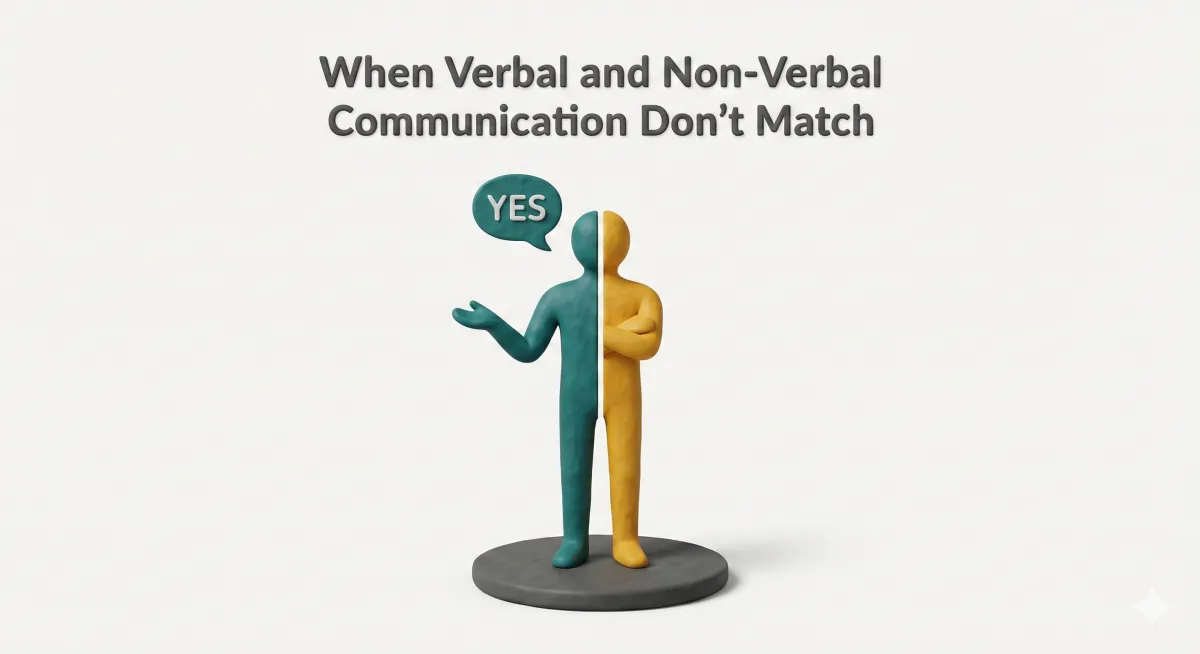
When Verbal and Non-Verbal Communication Don't Match: A Guide for Allied Health Clinicians
An allied health clinician is reviewing a home program with Maya, a 38-year-old client who's been struggling with adherence. The clinician asks, "How are you going with the program we discussed?"
Maya immediately responds, "Yeah, good, I'm following it," while simultaneously looking down, shifting in her chair, and her voice trails off at the end.
The clinician, relieved to hear adherence, moves on to the next topic.
But Maya's body told a completely different story than her words—and the clinician missed it entirely.
The Gap Between Words and Truth
Albert Mehrabian's research on communication reveals something that should stop every clinician in their tracks: only 7% of emotional meaning comes from the actual words people say. The remaining 93% comes from tone of voice (38%) and body language (55%).
When Maya says "I'm following it" whilst looking away and shifting uncomfortably, which message should you believe?
Most clinicians default to accepting the verbal response. It's easier. It's what we're trained to document. And frankly, when you're running behind schedule, a quick "yes" feels like permission to move forward.
But that's exactly when treatment plans start to unravel.
Why Patients Say What You Want to Hear
Maya isn't lying. She's protecting—herself from your disappointment, you from having to deal with her failure, feeling guilty and the relationship from potential conflict.
Research in Motivational Interviewing by William Miller and Stephen Rollnick demonstrates that patients often experience what's called "pleasing behaviour"—they tell clinicians what they believe will maintain approval and avoid judgment.
Consider what's happening in Maya's mind when you ask about adherence:
If I admit I haven't done it, they'll think I don't care
They've spent so much time explaining this, I don't want to disappoint them
Maybe if I just say yes, I can start fresh this week
I feel embarrassed that I couldn't manage something so simple
The verbal "yes" is Maya's social shield. The non-verbal cues—the averted gaze, the shifted posture, the trailing voice—those are her truth leaking out.
The Cost of Missing the Mismatch
When you accept Maya's verbal "yes" without addressing the non-verbal "no," several things happen:
Treatment plans fail. You build your next intervention on the assumption that she's been following the program. When she returns in two weeks with no progress, you're both confused and frustrated.
Trust erodes. Maya knows she wasn't honest. You sense something's off but can't name it. The therapeutic alliance weakens with every mismatch you don't address.
Resistance grows. Each time Maya offers a false "yes" and you accept it, she moves further from genuine engagement. The gap between what she says and what she does widens.
Your clinical reasoning gets compromised. You make treatment decisions based on inaccurate information. Maya's outcomes suffer and you can't understand why your clinically sound approach isn't working.
The mismatch itself isn't the problem. The problem is treating the mismatch as if it doesn't exist.
Reading the Signals
Before you can address incongruence, you need to notice it. Chris Voss's work in Never Split the Difference emphasises that exceptional negotiators—and exceptional clinicians—don't just listen to words. They observe everything.
Common non-verbal signals that contradict verbal compliance:
Eye contact disruption: Maya says "yes" but looks away, down, or at the clock
Posture shifts: Crossing arms, leaning back, or creating physical distance whilst agreeing
Tone mismatch: Words sound affirmative but tone is flat, hesitant, or questioning
Micro-expressions: A quick grimace, lip bite, or furrowed brow that flashes before the verbal response
Delayed response: A pause before "yes" that suggests internal conflict
Trailing speech: Sentences that fade out as if the speaker is losing confidence in their own words
Fidgeting or tension: Hands clenching, foot tapping, jaw tightening whilst verbally agreeing
When you notice a mismatch, that's your signal to pause. Not to ignore. Not to accept at face value. To pause.
Four Techniques for Addressing the Mismatch
1. The Pause and Notice Technique
When Maya responds with "Yeah, good, I'm following it," don't immediately move to your next question. Pause. Let two seconds of silence sit between you.
In that pause, scan:
Where are her eyes?
What's her posture telling you?
Does her tone match her words?
Is there tension in her body?
This deliberate pause does two things: it gives you time to notice incongruence and it gives Maya space to self-correct if she wants to.
Often patients will use that silence to add a qualifier: "Well... mostly" or "I've been trying" or "It's been difficult this week."
That's when the real conversation begins.
2. The Gentle Label
This technique comes directly from Chris Voss's tactical empathy approach. When you spot a mismatch between verbal and non-verbal communication, name what you observe—without judgment or accusation.
Instead of: "Are you sure you're doing the program?" (This creates defensiveness)
Try: “It feels like you might be struggling a little (upward inflection)?”
Other labelling phrases that work:
"It sounds like you're uncertain about something..."
"You seem hesitant, even though you're saying yes..."
"I'm sensing there's something else you're not quite saying..."
The pause after your label is crucial. Don't fill the silence. Let Maya respond to what you've observed. Often, the truth emerges in that space.
3. The Permission to Be Honest
Maya's false "yes" often stems from believing that you need to hear "yes." She thinks disappointment or judgment will follow if she admits she hasn't followed through.
Your job is to explicitly remove that barrier.
Try: "Maya, it's completely okay if the program hasn't been working for you—I'd rather know now so we can adjust it together. What's actually been happening?"
This creates what psychologists call "psychological safety." You're signalling that honesty won't result in negative consequences. You're positioning yourself as collaborative rather than authoritative.
Phrases that create permission:
"There's no wrong answer here—I just want to understand what's really going on"
"Most people find this difficult to maintain. What's been your experience?"
"I'm not here to judge whether you've done it—I'm here to help you find something that actually works for you"
When you give explicit permission for honesty, Maya's non-verbal and verbal communication start to align. The tension releases because the truth is now safe.
4. The Curiosity Follow-Up
When you've labelled the mismatch and created safety, follow with questions that invite truth-telling rather than questions that encourage continued compliance theatre.
Instead of: "So you'll keep doing the program this week?" (Closed question, invites false agreement)
Try: "What's making it difficult to follow the program?" (Open question, assumes difficulty and invites honesty)
Other curiosity-driven questions:
"What would need to change for this to feel doable for you?"
"When you think about doing the program, what comes up that makes you hesitate?"
"What part of this feels most out of reach right now?"
Notice the presupposition in these questions: you're not asking if there's difficulty, you're assuming there is and inviting Maya to tell you about it.
This approach, grounded in Clean Language principles, removes the pressure to maintain the fiction of compliance and instead focuses on understanding the real barriers.
What This Looks Like in Practice
Let's return to Maya and replay the interaction:
Clinician: "How are you going with the program we discussed?"
Maya: "Yeah, good, I'm following it." (Eyes drop, shoulders shift back slightly, voice trails off)
Clinician: (Two-second pause while observing body language) "You're saying you're following it, but it seems like you might be struggling?"
Maya: (Shoulders relax slightly) "Honestly? I tried the first few days, but then work got really busy and I just... didn't keep it up."
Clinician: "That makes sense. Most people find it challenging to maintain new routines when life gets hectic. What would need to change for this to feel more doable?"
Maya: "I think I need something manageable. By the time I get home, I'm exhausted and what you’re asking feels impossible."
Clinician: "Okay. What if we broke things down into more manageable chunks? Something that still moves you forward but doesn't require energy you don't have?"
Maya: (Makes eye contact, leans forward slightly) "That would actually be really helpful."
Notice what happened: the clinician named the mismatch without judgment, created explicit safety for honesty, and used curiosity to understand the real barrier. Maya's verbal and non-verbal communication aligned once the truth became safe.
The result? A treatment plan that might get done or lifestyle changes that might actually happen.
The Compound Effect of Addressing Mismatches
When you consistently notice and address the gap between what patients say and what their bodies show, several things shift:
Patients become more honest. They learn that you're not fishing for the "right" answer—you genuinely want to understand their experience.
Your clinical reasoning improves. You're working with accurate information about adherence, barriers and patient motivation.
Trust deepens. Patients feel truly seen and heard, not just documented.
Treatment plans become reality-based. You design interventions that account for what's actually happening in patients' lives, not what you wish was happening.
Your frustration decreases. You're no longer surprised by non-adherence because you've been having honest conversations about it all along.
Daniel Kahneman's research in Thinking, Fast and Slow demonstrates that humans are remarkably poor at detecting deception when we're not actively looking for incongruence.
We tend to accept verbal statements at face value because our brains are wired for efficiency, not accuracy.
But clinicians who train themselves to pause and notice—who actively look for the gap between words and bodies—create a different kind of clinical relationship. One where truth is expected, welcomed, and used to build better outcomes.
Moving Forward
Think about your next clinic session. Before you ask a patient about adherence, commitment, or understanding, decide to pause after their response. Give yourself at least two seconds to notice:
Does their body match their words?
If not, what is their body telling you that their words won't?
Then practice naming what you observe. Not in judgment, but in curiosity.
Because Maya doesn't need another clinician who accepts her false "yes" and wonders why treatment isn't working.
Maya needs a clinician who notices the mismatch and cares enough to explore what's really happening.
That clinician could be you.
Want to shift from lecturing to collaborating? I offer communication coaching for experienced clinicians who want to master behaviour change conversations. Contact me to explore how this work could transform your clinical practice.
Communication isn't a soft skill—it's a results skill. And you don't have to master it alone.
Further Reading and References
Mehrabian, A. (1971). Silent Messages: Implicit Communication of Emotions and Attitudes – The foundational research on verbal vs. non-verbal communication
Never Split the Difference by Chris Voss – Tactical empathy and labelling techniques for recognising and responding to incongruence
Motivational Interviewing: Helping People Change by William R. Miller and Stephen Rollnick – Understanding patient ambivalence and pleasing behaviour
Thinking, Fast and Slow by Daniel Kahneman – How our cognitive biases prevent us from noticing deception and incongruence
The Coaching Habit by Michael Bungay Stanier – Asking questions that reveal truth rather than encourage compliance
I am a Clinical Communication & Behaviour Change Explorer with over 30 years of experience helping Allied Health Clinicians master the human side of healthcare. Through coaching, workshops, and practical frameworks, she helps experienced practitioners turn resistance into engagement and frustration into confident action.