When your mentee knows less than they think
You are working through a case with your mentee when you notice it.
They move past something quickly. A piece of underlying knowledge, a bit of reasoning, a basic principle they treat as settled. They say it with confidence and carry on, building their next thought on top of it.
And you can see, quietly, that the foundation is not as solid as they believe.
Maybe it is anatomy. Maybe it is a clinical principle, a piece of physiology, a reasoning step, a how or a why they think they have but do not quite. The specifics do not matter. What matters is the gap between how sure they feel and how secure the knowledge actually is.
This is one of the most delicate situations in mentoring. And it is far more common than we admit.
Why confident gaps are normal, not a failing
It is tempting to read overconfidence as arrogance. Usually it is not.
It is simply how knowledge feels from the inside. We do not have a reliable internal gauge for what we do not know. The less complete someone's understanding of a topic, the harder it is for them to see what is missing, because the very knowledge they would need to spot the gap is the knowledge they lack.
Daniel Kahneman (Thinking, Fast and Slow) describes how the mind builds a coherent story from whatever information it has and feels confident in that story, regardless of how thin the underlying evidence is. Confidence tracks the smoothness of the story, not the completeness of the facts.
So your experienced mentee, reasoning fluently through a case, genuinely feels they have the foundation. The fluency itself is convincing. To them, there is no gap to see.
This is worth holding onto, because it changes how you respond. You are not dealing with someone being difficult. You are dealing with a normal feature of how all of us hold knowledge, yourself included. That softens the whole encounter.
Why it still matters
If overconfidence is so normal, why not let it go?
Because it does not stay theoretical.
An experienced clinician's confident gap does not sit harmlessly in a mentoring conversation. It travels. It reaches a patient, a clinical decision, a treatment choice. It reaches the junior staff your mentee is themselves guiding, who absorb the gap as fact because it was delivered with such certainty.
The more senior the person, the further the ripple. Confidence is contagious, and so is the error underneath it.
So this is not pedantry, and it is not about being right. It is about the quiet duty of a mentor to make sure that what travels onward is sound. That is precisely why the delicacy matters. You cannot ignore it, and you cannot afford to handle it clumsily.
Why direct correction backfires
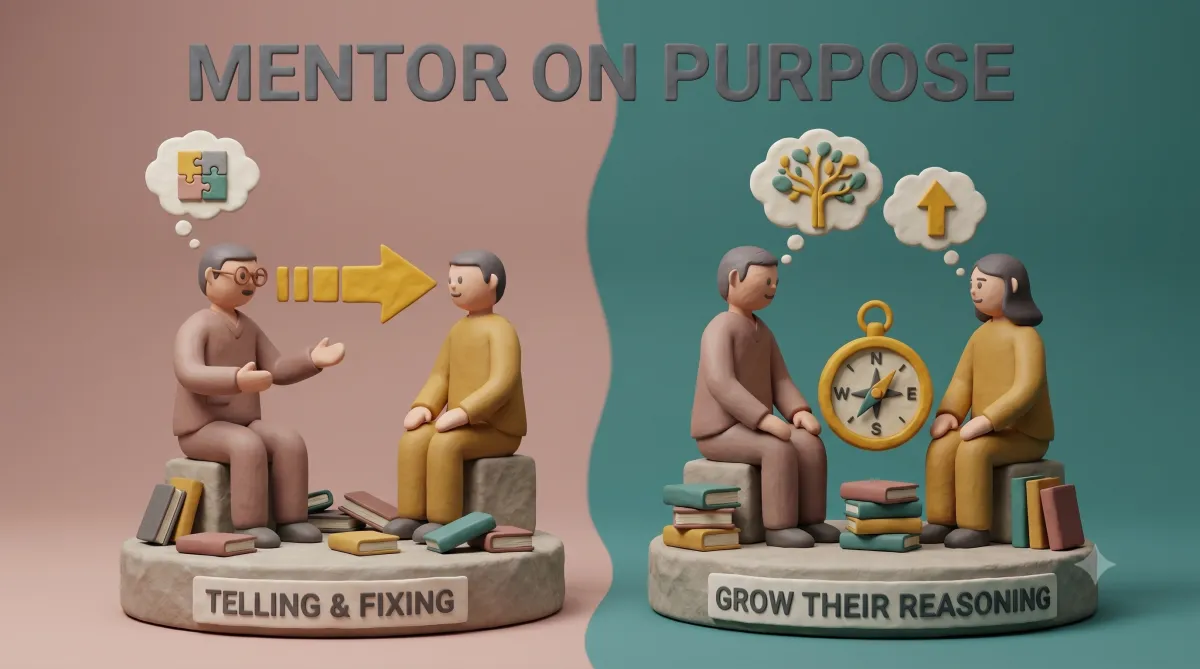
Here is the instinct, and it is a good-hearted one. You spot the gap, so you fill it. "Actually, it works a little differently. Let me explain."
It rarely lands the way you hope.
The moment you correct a confident person directly, something shifts in the room. They were reasoning openly a second ago. Now they are defending. The energy moves from learning to protecting, and a defended mind takes nothing in.
Miller and Rollnick (Motivational Interviewing) gave us the phrase for this: the righting reflex. The urge to set someone straight, to fix the error you can see. It feels helpful. It usually produces the opposite of what you want, because people do not adopt conclusions they feel pushed towards. They dig in.
Resistance, in their framing, is not stubbornness. It is a signal that the person's sense of autonomy or competence is under threat. Correct an experienced clinician in front of their own gap and you threaten both at once. The resistance you meet is not a character flaw. It is the predictable response to being told you are wrong.
So the goal is not to correct. The goal is to help them see the edge of their own knowledge for themselves. What a person discovers, they own. What they are told, they argue with.
The skill: let them find the edge
The most respectful and effective move is to ask questions that gently walk the mentee up to the boundary of what they actually know, until they bump into it themselves.
You are not testing them. You are not laying a trap. You are genuinely curious about their thinking, and that curiosity does the work.
A few ways to invite it:
Ask them to explain it. "Talk me through how that works." Explaining out loud is where fuzzy knowledge reveals itself. Things that felt solid in the head wobble when they have to be said in sequence.
Ask them to apply it. "How would that change if this patient also presented with X?" Application stretches knowledge past the memorised version into the place where real understanding either holds or does not.
Ask them to teach it. "If you were explaining this to a new grad, how would you put it?" Teaching is the most exposing test of all, in the kindest way. The gaps surface naturally, and the mentee finds them rather than being shown them.
Nancy Kline (Time to Think) reminds us that people think best in the presence of genuine attention and genuine questions, not interruption. Your job here is to ask, then get out of the way. Let the silence do its work. The moment of "actually, hang on..." is the whole point, and it has to be theirs.
When they reach the edge, you will often see it land softly. "Hmm, I'm not as sure about that as I thought." That sentence is gold. It is the door opening from the inside.
Asking permission without bruising
There is one more piece, and it is a small communication move that makes the whole thing easier.
Before you start probing, you want the mentee on side. But if you ask for that too directly, you signal that something is wrong. "Can I just check your understanding of this?" puts them on guard before you have begun.
So ask in a way that hands them control rather than putting them on the spot.
Chris Voss (Never Split the Difference) noticed that people do not relax when they say yes. They relax when they are free to say no. A yes can feel like a concession. "No" feels safe, because it is theirs. When someone knows they can decline, they engage more openly, not less.
So frame it as a no-oriented question, where the comfortable answer is no.
Not: "Can I ask you some questions about this?"
But: "Would you be against walking me through your thinking on it first, before I add anything?"
To say no to that is to agree to be explored, and it arrives with no pressure at all. The mentee keeps control of the conversation. You keep quiet hold of its direction. That balance, their autonomy and your intention, is what lets the exploration feel collaborative rather than like a quiet exam.
The same principle that drives adherence
If this feels familiar, it is because it is the same truth that sits underneath patient follow-through.
In the adherence work, the central point is that people do not act on what they are told. They act on what they have worked out and chosen for themselves. Tell a patient what to do and you get polite agreement that fades by the car park. Help them reach their own conclusion and it holds.
A mentee is no different. Hand them a correction and they defend it. Help them discover the gap themselves and they close it, willingly, and they remember how they got there.
This is why none of this is manipulation. A manipulation steers someone towards your answer while letting them think it was theirs. This does the opposite. The realisation genuinely is theirs, which is exactly why it changes anything. You are not engineering a conclusion. You are creating the conditions for an honest one.
Holding the relationship while you do it
A last word on tone, because it carries the whole thing.
Throughout, your manner says one thing: I am with you, not above you. You are not the keeper of the right answer waiting for them to fail. You are a colleague, curious alongside them, who happens to be asking the questions.
When the gap surfaces, you meet it lightly. No told-you-so, no relief at being right. "Great, that's a really useful thing to have noticed. Want to dig into it together?" The discovery stays a shared win, not a quiet defeat.
Edgar Schein (Humble Inquiry) calls this building a relationship where it is safe to not know. That safety is the real product of good mentoring. A mentee who feels safe to find their own edges will keep finding them long after you have stopped meeting, which is the entire point.
Try this, this fortnight
Next time you spot a mentee confident in something that is not as solid as they think, resist the urge to correct:
Ask permission with a no-oriented question: "Would you be against talking me through your thinking on this first?"
Invite them to explain, apply, or teach it back to you.
Stay quiet at the edge. Let them reach the "actually, I'm not sure" themselves.
Meet the gap lightly, as a shared discovery, then explore it together.
You will fill the gap either way. The difference is whether your mentee walks away defended, or genuinely changed.
If this is the kind of thinking you want to bring into your practice or your team, explore how I work with clinicians and clinics here: https://annettetonkin.com/services
Mentoring Mastery is for experienced clinicians who already guide others and want to do it with more skill, structure and intention. You can read about it here: https://annettetonkin.com/program-structure-and-participation
Books referenced in this article
Thinking, Fast and Slow - Daniel Kahneman
Motivational Interviewing - William Miller and Stephen Rollnick
Time to Think - Nancy Kline
Never Split the Difference - Chris Voss
Humble Inquiry - Edgar Schein