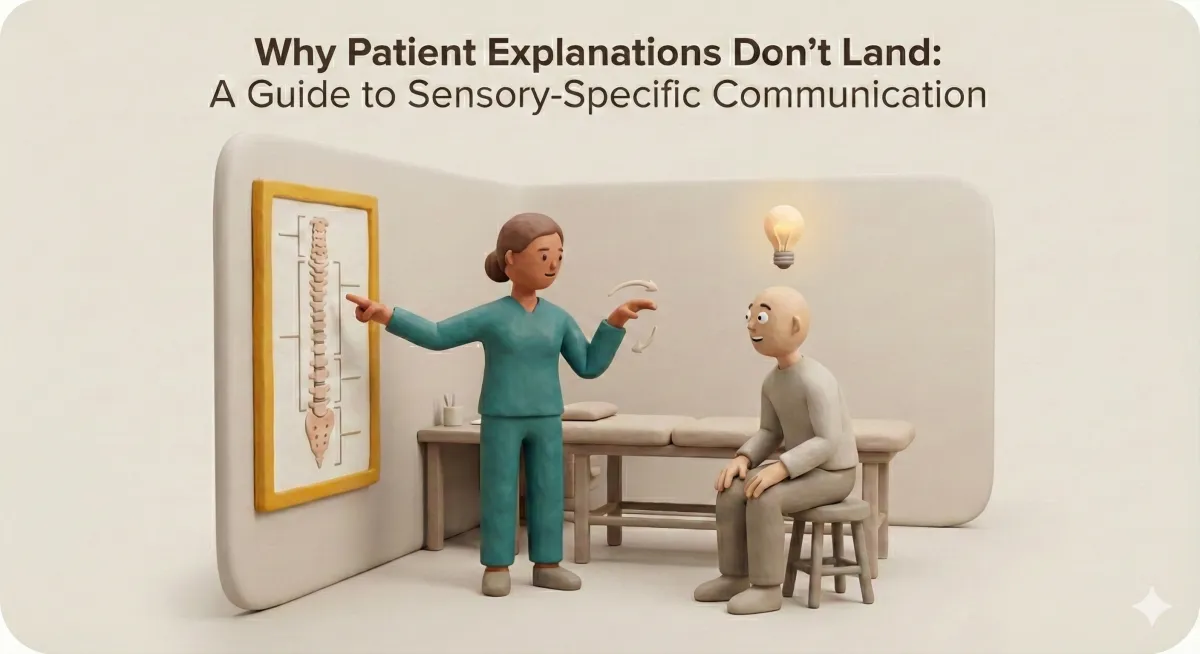
Why Patient Explanations Don't Land: A Guide to Sensory-Specific Communication
You've explained the same exercise three times. You've used diagrams. You've broken it down step by step. But the patient still looks lost.
"I just don't get it," they say.
It's not that they're not trying. It's not that you're unclear. And it's certainly not about intelligence.
Sometimes, the problem is simpler than we think: we're explaining in a language their brain isn't wired to process efficiently in that moment.
The Science Behind Sensory Language
Here's a few things we know from research: people process information through different sensory channels and the language they use reveals which channel they're currently accessing.
This isn't about fixed "learning styles"—a concept that's been thoroughly debunked by cognitive science research.
Rather, it's about recognising that in any given moment, people naturally favour certain sensory words that correspond to how they're trying to make sense of information.
Research has consistently failed to find evidence that matching instruction to supposed learning styles improves outcomes, with cognitive load theory demonstrating that presenting information through complementary modalities reduces mental effort and enhances understanding.
What matters isn't labelling someone as a "visual learner"—it's recognising that working memory can be expanded when verbal and visual information are presented contiguously, as they build referential connections between mental representations.
The practical application? When patients use sensory-specific language, they're signalling how they're currently trying to process your explanation.
Match that mode and comprehension improves—not because of innate learning styles, but because you've reduced cognitive load by presenting information in a format their brain is already primed to receive.
Why Explanations Don't Land
Think about your last challenging patient conversation. Perhaps you explained a movement pattern using anatomical terms, but the patient responded, "I can't picture what you mean." Or you demonstrated a technique, and they said, "That doesn't sound right to me."
These aren't random phrases. They're signals.
Research on communication with patients demonstrates that supportive verbal strategies, including appropriate pacing and avoiding complex terminology, significantly enhance professional-patient interaction.
But there's another layer: the sensory words patients use reveal how they're trying to understand you.
When a patient says "I can't see how this helps," they're not being metaphorical—they're telling you their brain is trying to create a visual representation of your explanation and it's not working.
The challenge isn't about your clinical knowledge. It's about the mismatch between how you're explaining and how they're processing.
The Three Processing Preferences: Used Lightly
Before we go further, I want to be clear what this isn’t about: this is not about categorising patients into rigid types.
The learning styles theory has been thoroughly discredited, with research showing that matching instruction to supposed preferences doesn't improve learning.
What we're discussing is far more subtle and dynamic: paying attention to the sensory language patients use in real time and adjusting your explanation accordingly.
Think of it less as "this patient is visual" and more as "right now, in this moment, this patient is using visual processing."
Here's what to listen for:
Visual Processing Cues
When patients are trying to create mental images, they might say:
"I can't picture it"
"I don't see how that works"
"Show me what you mean"
"It's still unclear to me"
"Can you draw that?"
They're trying to create a visual representation in their mind. Your verbal explanation—no matter how clear—isn't giving them what they need.
Auditory Processing Cues
When patients are trying to understand through sound or internal dialogue, they might say:
"That doesn't sound right"
"I hear what you're saying, but..."
"Tell me again how this helps"
"Can you explain it differently?"
"Something about that rings a bell"
They're processing through verbal explanation, internal narration, or the rhythm of how information sounds. Showing them a diagram might not help as much as walking through the logic verbally.
Kinaesthetic Processing Cues
When patients need to feel or experience information physically, they might say:
"I can't get a grip on this"
"It doesn't feel right"
"I need to feel what you mean"
"Can I try it?"
"I'm not comfortable with that yet"
They're trying to understand through physical sensation and movement. Talking or showing won't be as effective as letting them experience it.
The Critical Caveat: Don't Label, Just Listen
Please, don't walk away from this article thinking, "Right, I need to work out if each patient is visual, auditory, or kinaesthetic."
That's exactly the trap that learning styles theory fell into—and exactly why it doesn't work.
Instead, think of this as a real-time listening skill. People shift between processing modes depending on the task, their stress level and what they're trying to understand.
Your patient might use visual language when you're explaining anatomy, auditory language when you're discussing their treatment plan and kinaesthetic language when you're teaching an exercise.
The goal isn't to categorise. It's to notice, adjust and stay flexible.
Practical Micro-Adjustments That Improve Understanding
Let's look at how this works in practice with the same clinical scenario, adjusted three different ways.
Scenario: Teaching a patient pelvic floor activation
When They Give You a Visual Cue
Patient: "I can't really picture where you mean."
Missed opportunity: Continue with the same verbal explanation.
Adjusted response: "Let me show you on this model. See this area here? When you activate, imagine this muscle lifting up like a platform. Some people find it helps to visualise the number eight around these openings—when you engage, imagine tightening that figure eight."
Why it worked: You matched their visual processing by giving them concrete images to work with.
When They Give You an Auditory Cue
Patient: "That explanation doesn't quite sound right to me."
Missed opportunity: Pull out a diagram or model.
Adjusted response: "Let me talk you through it differently. Think about the sensation in steps: first, you'll notice a gentle drawing up. Then, as you hold it, you might hear yourself thinking 'am I doing this right?'—and that's normal. The key is the sequence: engage, hold, release. Engage, hold, release. Like a rhythm."
Why it worked: You matched their auditory processing by giving them verbal sequencing and internal dialogue to follow.
When They Give You a Kinaesthetic Cue
Patient: "I just can't feel what you're describing."
Missed opportunity: Give them more explanation or more diagrams.
Adjusted response: "That makes sense—this is tricky to get without trying it. Let's have you place your hand here so you can feel the movement. Now, try a gentle lift. Feel that? Now try it without your hand—can you get that same feeling? Let's try it a few times until it feels more natural."
Why it worked: You matched their kinaesthetic processing by giving them physical feedback and repetition to build the sensation.
What to Ask When You're Unsure
If you're not picking up clear cues, here are three questions that invite patients to show you their processing preference:
"Would it help if I showed you, talked you through it, or had you try it?"
Simple. Direct. Lets them choose.
"What would make this clearer for you—a diagram, a different explanation, or trying it yourself?"
Gives three clear options without putting them on the spot.
"How do you usually figure out new movements—by watching, listening, or doing?"
Metacognitive. Helps them reflect on what works for them.
These questions aren't just polite—they're diagnostic. The answer tells you which adjustment to make.
Small Adjustments, Big Impact on Adherence
Why does this matter for treatment outcomes?
Because comprehension drives confidence. And confidence drives follow-through.
When patients genuinely understand what they're meant to do—not just intellectually, but in a way that makes sense to their brain—they're far more likely to actually do it.
Cognitive load research demonstrates that when information is presented through complementary sensory channels, working memory capacity increases, leading to better retention and application.
Matching sensory preferences isn't about being a better entertainer. It's about reducing the cognitive effort required to understand you. And when understanding feels easier, adherence improves.
This might just be good communication. And honestly? That's enough.
What This Means for Your Practice
You don't need to overhaul your entire approach. You don't need to assess every patient's "type." What might be helpful to do is:
Listen for sensory words in how patients respond to your explanations
Adjust your delivery to match what they're signalling
Stay flexible—they'll shift between modes and so should you
Offer choices when you're not sure which adjustment to make
This isn't about adopting NLP theory wholesale. It's about recognising a simple clinical reality: sometimes the reason your explanation doesn't land has nothing to do with clarity and everything to do with delivery mode.
When you adjust to match how a patient is processing in that moment—whether through images, words, or physical sensation—you reduce cognitive load, increase comprehension and improve the likelihood they'll follow through.
Working on your communication toolkit takes time—and you don't have to do it alone.
If you're recognising these patterns in your consultations and want to develop a more comprehensive approach to patient communication, that's exactly what I work on with clinicians in my coaching programs.
We go beyond individual techniques to build a complete communication framework that addresses resistance, improves adherence and helps you feel more confident in difficult conversations.
If you're ready to move from frustrated to curious, I offer communication coaching for experienced clinicians who want to master behaviour change conversations. Contact me to explore how this work could transform your clinical practice.
Communication isn't a soft skill—it's a results skill. And you don't have to master it alone.
Mentoring Mastery — the next cohort starts on 9 September 2026. If you are mentoring or supervising others and want a more intentional, structured way to do it, get in touch and I'll send you the details.
Patient Adherence & Communication begins on 15 September 2026 — do reach out if you'd like more information about either course.
References
Constantinidou, F., & Baker, S. (2002). Stimulus modality and verbal learning performance in normal aging. Brain and Language, 82(3), 296-311.
Kavale, K. A., & Forness, S. R. (1987). Substance over style: Assessing the efficacy of modality testing and teaching. Exceptional Children, 54(3), 228-239.
Mayer, R. E., & Moreno, R. (2003). Nine ways to reduce cognitive load in multimedia learning. Educational Psychologist, 38(1), 43-52.
Moreno, R., & Mayer, R. E. (1999). Cognitive principles of multimedia learning: The role of modality and contiguity. Journal of Educational Psychology, 91(2), 358-368.
Newton, P. M., Najabat-Lattif, H. F., Santiago, G., & Salvi, A. (2021). The learning styles neuromyth is still thriving in medical education. Frontiers in Human Neuroscience, 15, 708540.
Pashler, H., McDaniel, M., Rohrer, D., & Bjork, R. (2009). Learning styles: Concepts and evidence. Psychological Science in the Public Interest, 9(3), 105-119.
Willingham, D. T. (2005). Do visual, auditory, and kinesthetic learners need visual, auditory, and kinesthetic instruction? American Educator, 29(2), 31-35.
I am a Clinical Communication & Behaviour Change Explorer with over 30 years of experience helping Allied Health Clinicians master the human side of healthcare. Through coaching, workshops, and practical frameworks, she helps experienced practitioners turn resistance into engagement and frustration into confident action.