![[Annette Tonkin] - Tekmatix Website](https://assets.cdn.filesafe.space/YwBoSBds2e2fV0DTgMML/media/6a7e8ca899074f5ef62ea353.png)
FREE RESOURCE FOR ALLIED HEALTH CLINICIANS
They nodded. They agreed. They did none of it.
Nine beliefs about patient motivation that sound sensible, and quietly cost you results.
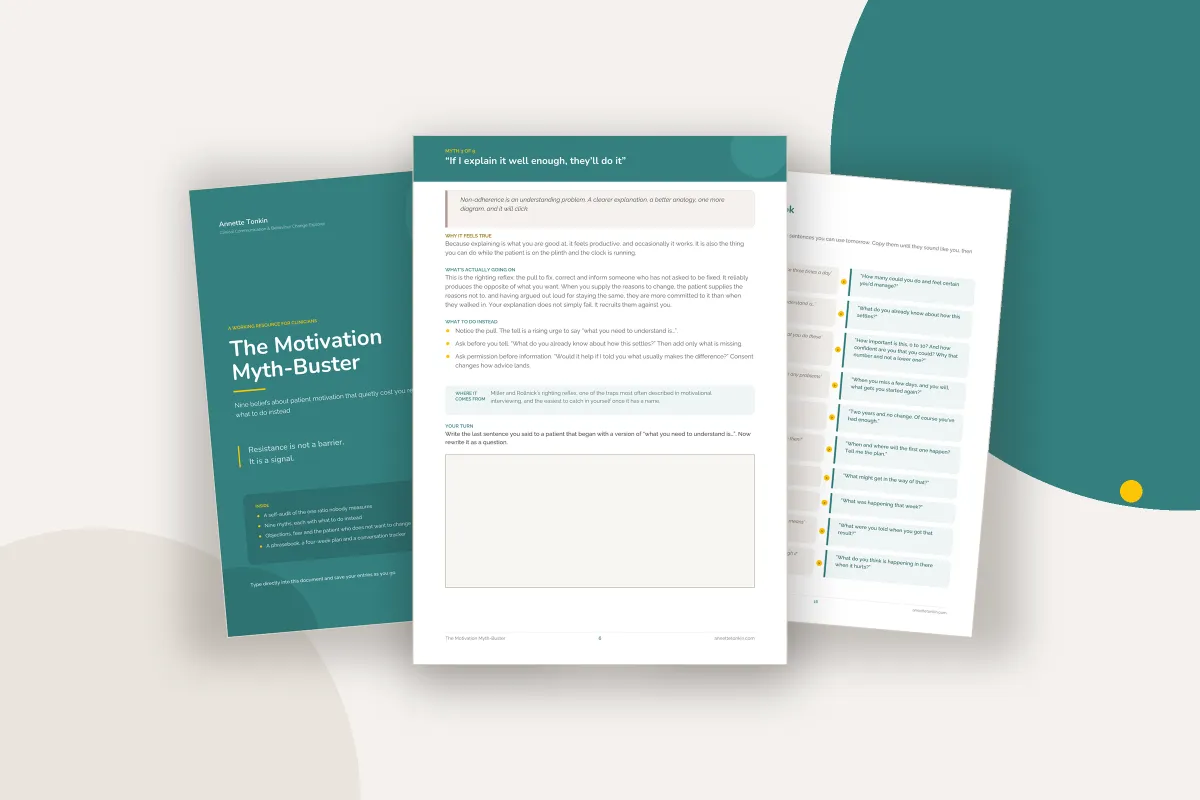
You explained it well. They understood. They agreed the exercises mattered and said they would find the time.
Then they came back a fortnight later having done nothing, and somewhere between the notes and your own head, the word 'unmotivated' crept into your thinking.
It seemed the most reasonable conclusion available, and it is the one that makes the next conversation more challenging.
Because wanting something and doing it run on different systems. A patient can want the outcome badly, understand exactly why it matters, and still have no plan, no confidence in their technique, and no gap in the week where it could happen. None of that responds to more motivation. Most of it does not respond to more explanation either, which is the part that catches us out, because explaining is what we are good at and it feels like progress.
A 19-page working PDF. It arrives in your inbox in a minute or two. Type straight into it and save as you go. Privacy
A resource you work through, not one you read
Nine myths. Each one gets the belief, why it feels true, what is actually going on, and what to do instead. Then a box, and you write in it.
Reading about communication has never changed anyone’s next consultation. Writing down one sentence you will actually say has a better record of changing your habits.
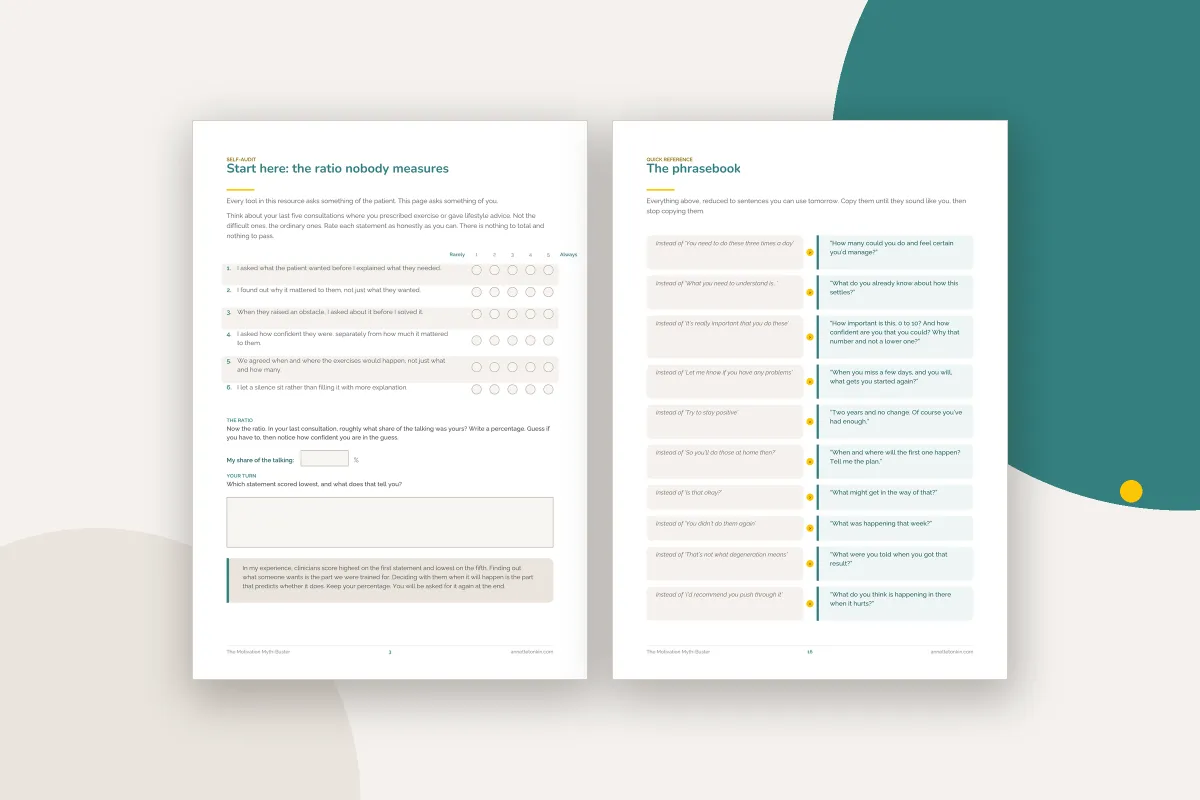
A self-audit of the one ratio nobody measures: how much of your last consultation was you talking
Nine myths, each with the phrasing to replace them, from "they’d do it if they really wanted to" through to "there’s no time for this in a real clinic"
The patient who disagrees with you, and what to do instead of correcting a scan report they are quoting at you
How to tell fear from low motivation, because they look identical and need opposite responses
What to say when someone genuinely doesn’t want to change, and why that is often the moment they do
A phrasebook of ten swaps you can use tomorrow
A four-week practice plan and a conversation tracker, so one thing changes rather than nine things being interesting
Where the evidence is thin, I says so
You are the audience most likely to check, so a note on how this is built.
Every claim that needs a source names one, and where the research is weaker than the popular version suggests, the page says so rather than rounding it up. Implementation intentions are the clearest example.
Implementation intentions are widely quoted as though deciding when and where roughly doubles follow-through. The resource says instead that the effect across goals generally is substantial, that in physical activity specifically it is modest, and that in the trials it only reached significance where the plan was revisited at a later visit.
That is a less satisfying sentence and a more useful one, because it tells you the follow-up is the part that matters.
Behind it: Miller and Rollnick, Michie, Gollwitzer and Sheeran, Magill, Rubak, Marlatt, Bunzli, Vlaeyen and Rogers.
Who it’s for, and who wrote it
For experienced clinicians. Physiotherapists, occupational therapists, exercise physiologists, dietitians, podiatrists, chiropractors, osteopaths. Anyone whose results depend on what a patient does between appointments. It assumes you already know what the patient should be doing, and it is about the conversation that decides whether they do it.
I am a physiotherapist of more than thirty years, a clinic owner and educator. Myth 2 is about me. I was given a set of exercises by a physiotherapist I respected. I understood exactly why they mattered, I wanted to do them, and I did not do a single one. Nobody asked me what I needed to do to fit the exercises into an already very busy week.
Nine myths, some of your time, and one thing that changes
Read it in one sitting or two. Type straight into it and save as you go, or print it and write on it. It is yours either way.
Free. I don’t share your address with anyone. Privacy
If you want to go further than one resource can take you, the Patient Adherence & Communication Training runs over four sessions and covers this properly.

Driving adherence and clinical outcomes


Get In Touch
Location: 26 Akala Street , Flaxton Queensland 4560
Phone: 0417 817 388
Email: [email protected]