
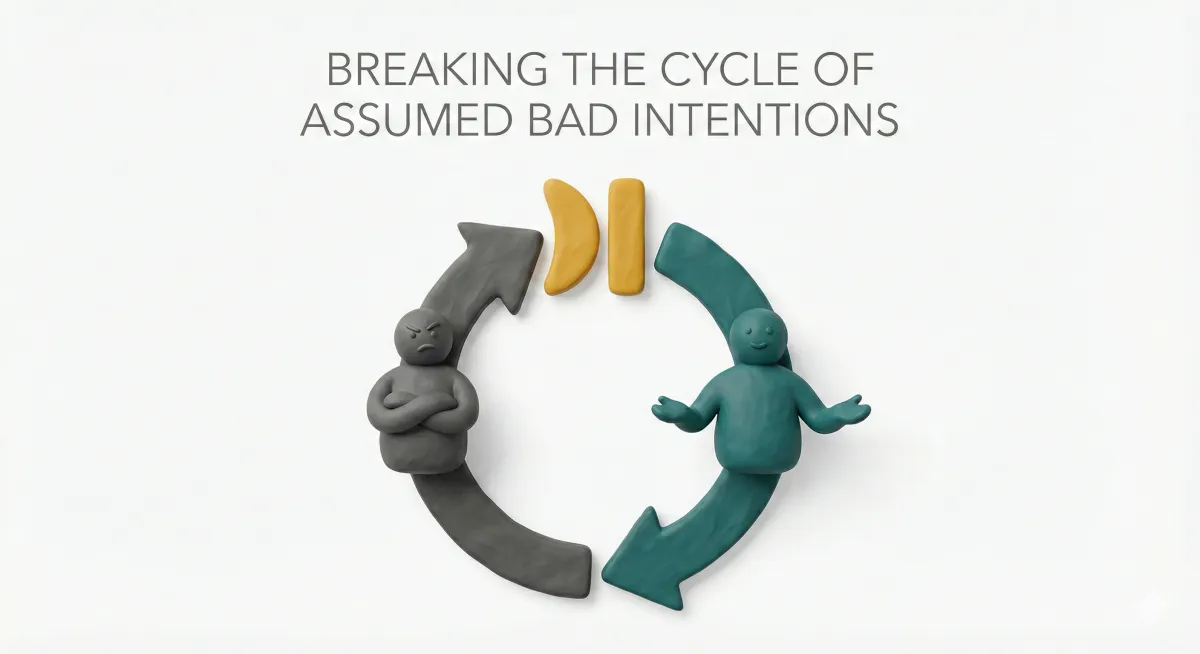
Breaking the Cycle of Assumed Bad Intentions: A Path to Better Conversations
In his influential book, Difficult Conversations, Douglas Stone brings to light a powerful insight: "When we think others have bad intentions toward us, it affects our behaviour. And in turn, how we behave affects how they treat us.
Before we know it, our assumption that they have bad intentions towards us comes true.
This quote beautifully encapsulates a dynamic we often experience but rarely stop to consider. Our perceptions and assumptions can create a self-fulfilling prophecy, especially when we’re dealing with challenging conversations or conflict.
By assuming that someone has negative intentions, we may unwittingly act in ways that bring out the worst in them, confirming our initial fears. This cycle, once started, can be incredibly difficult to break.
So, how can we stop assuming bad intentions? Let’s explore how this cycle unfolds, why it matters and actionable ways to disrupt it to build healthier and more productive communication.
The Impact of Assumed Bad Intentions
Assuming bad intentions can trigger a cascade of reactions:
- Shifting Mindsets: When we believe someone intends to harm us or undermine our goals, our mindset shifts defensively. This can influence our tone, our body language and our choice of words.
- Escalating Conflict: A defensive or aggressive response from us is likely to provoke a similar reaction from the other person. As tensions rise, communication becomes increasingly difficult and the conversation can spiral into an unproductive argument.
- Creating Self-Fulfilling Prophecies: Stone points out that when we assume bad intentions, we start a cycle that can make those assumptions a reality. By acting as though the other person is out to get us, we often provoke reactions that align with our fears. This makes it easier to believe that our assumptions were correct, reinforcing the negative cycle.
At its core, this process comes down to our interpretation of someone else’s intentions, often coloured by past experiences, biases and emotions.
Why Assumptions Stick: The Role of Confirmation Bias
The concept of confirmation bias, explored by thinkers like Daniel Kahneman, suggests that we tend to seek, interpret and remember information that confirms our existing beliefs. When we assume someone has bad intentions, we may unconsciously seek out cues that support that view while overlooking anything that contradicts it.
This bias reinforces our assumptions, making it even harder to break the cycle.
In addition, when conversations become difficult, the amygdala in our brain — responsible for processing emotions like fear — can take over, often triggering a “fight or flight” response. This reaction can cloud our judgement and make it harder to approach situations with an open mind.
Breaking Free from the Cycle
So, how can we stop assuming bad intentions and break free from this counterproductive cycle?
Here are some strategies you can try:
1. Pause and Reflect
Before jumping to conclusions, take a moment to pause and reflect:
- Ask yourself, “Why do I think this person has bad intentions?”
- Consider other possible interpretations. What else could be influencing their behaviour?
By pausing and exploring alternative explanations, you create space to question your assumptions and approach the conversation with a more open mind.
2. Engage in Active Listening
Active listening, as taught by communication experts like Oscar Trimboli, involves fully focusing on the speaker and acknowledging their perspective. Instead of planning your response, try to understand their point of view.
- Paraphrase their statements to show that you’re listening.
- Ask clarifying questions to gather more context.
Active listening can reveal intentions you might not have considered and can help you respond more thoughtfully.
3. Challenge Your Internal Narratives
Consider the “ladder of inference” — a model that illustrates how we move from observing behaviour to making judgements. We often climb this ladder quickly, jumping from what we see to conclusions about intentions. To break the cycle, pause on each rung of the ladder:
- Describe what you observed without interpreting it.
- Reflect on the meaning you’re assigning and consider if it’s the only possibility.
This process, encouraged by thought leaders like Marilee Adams in her work on Change Your Questions, Change Your Life, helps us catch ourselves before making unfounded assumptions.
4. Assume Positive Intentions
While it may feel counterintuitive, adopting a mindset of assuming positive intentions can significantly shift the dynamics of difficult conversations.
- Try giving the other person the benefit of the doubt. Assume they mean well, even if their behaviour appears questionable.
- Express curiosity about their perspective. Ask them to explain their thought process.
Approaching situations with curiosity and assuming positive intentions can prevent defensiveness and open doors for understanding. Adam Grant, known for his work on Give and Take, often discusses how assuming the best of others can foster trust and create more productive interactions.
5. Use “I” Statements
When you assume bad intentions, it’s easy to lapse into accusatory language. Instead, try framing your thoughts with “I” statements, which focus on your feelings rather than blaming the other person:
- “I feel concerned about the outcome of this project when there’s a lack of communication.”
- “I notice that I feel stressed when there’s a delay, and I wonder how we can work together to improve it.”
This approach can reduce defensiveness and encourage collaboration, focusing on how you feel and what you need instead of pointing fingers.
Practical Exercise: Perspective Taking
To practice the skill of avoiding assumptions, try this simple exercise:
- Think of a recent difficult conversation where you assumed the other person had bad intentions.
- List three alternative explanations for their behaviour that do not involve negative intentions.
- Reflect on how your response might have differed had you considered these other possibilities.
This exercise helps you to question your default assumptions and prepares you to enter future conversations with a more open and understanding perspective.
Final Thoughts
Assuming bad intentions can be a powerful obstacle to effective communication, trapping us in a cycle of misunderstanding and conflict.
By adopting a mindset of curiosity, pausing to reflect and actively listening, we can break free from this cycle and approach difficult conversations with more empathy and open-mindedness.
The next time you find yourself assuming bad intentions, remember that how you choose to respond can change the outcome. With practice, you can transform difficult conversations into opportunities for growth, understanding, and collaboration.
Breaking this cycle isn’t easy, but it’s a worthwhile pursuit. How might shifting your assumptions change the way you communicate with others?
This journey towards more open-minded communication takes practice, but each step helps us build stronger, more meaningful connections. What will you do differently in your next conversation?
Communication isn't a soft skill—it's a results skill. And you don't have to master it alone.
Want to shift from making assumptions to collaborating? I offer communication coaching for experienced clinicians who want to master behaviour change conversations. Contact me to explore how this work could transform your clinical practice.
I am a Clinical Communication & Behaviour Change Explorer with over 30 years of experience helping allied health clinicians master the human side of healthcare. Through coaching, workshops, and practical frameworks, she helps experienced practitioners turn resistance into engagement and frustration into confident action.
If this was useful
Most of what looks like low motivation isn't. I've written up nine beliefs about patient motivation that sound sensible and quietly cost results, each with what to do instead and a box to write in.
Free, 19 pages, and you can type straight into it.