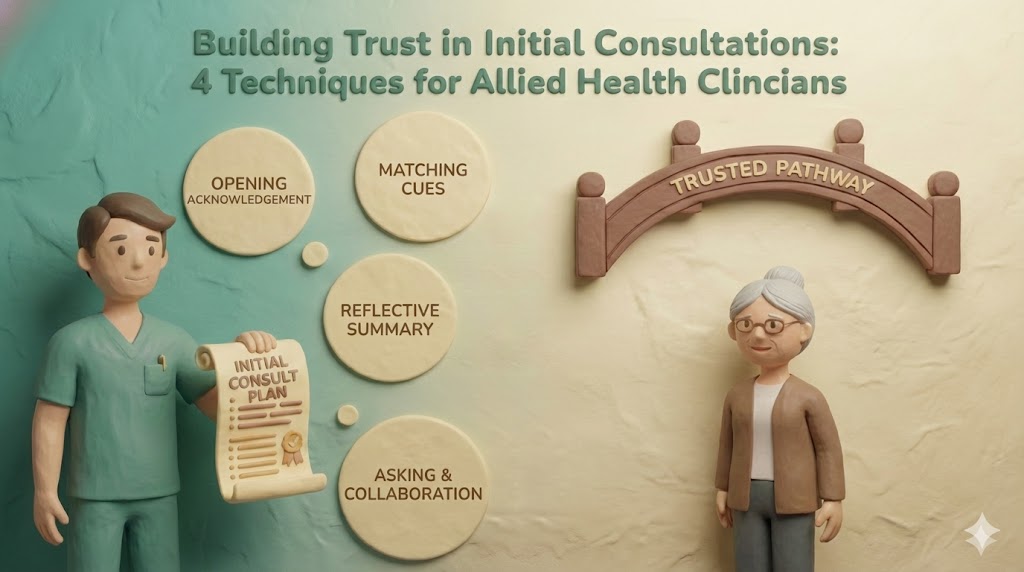
Building Trust in Initial Consultations: 4 Techniques for Allied Health Clinicians
An allied health clinician meets Jordan, a 45-year-old professional who's been referred for help managing a chronic condition that's affecting their daily function and quality of life. Jordan has seen two other practitioners in the past year.
Within the first few minutes of the consultation, the clinician notices Jordan's arms are crossed, their answers are brief and when asked about previous treatment attempts, they say "I've tried everything" with a slight edge in their voice.
The clinician senses resistance but isn't sure if it's scepticism, past disappointment, or something else entirely.
Sound familiar?
This crossroads moment happens in clinics every single day. How you respond in those first few minutes can determine whether Jordan leaves your consultation feeling heard and hopeful—or like they're just another appointment slot in your day.
Why First Impressions Set the Treatment Trajectory
Research from David Rock's SCARF model shows that our brains are constantly scanning for threat or reward in social interactions. Within seconds of meeting you, Jordan's brain is asking: Can I trust this person? Will they understand me? Am I safe here?
When patients arrive carrying the weight of past disappointments, their threat detection system is already on high alert. That edge in Jordan's voice? It's not resistance—it's self-protection.
Dr Amishi Jha's research on attention and anxiety demonstrates that when patients feel unsafe or uncertain, their ability to process and retain information diminishes significantly. They might hear your words, but they're not truly listening.
Their minds are busy scanning for danger signals: Is this clinician really listening? Are they judging me? Will they dismiss my concerns like the others did?
This is why building psychological safety quickly isn't a "nice to have"—it's essential. Without it, you're trying to build a treatment plan on shaky ground.
The Invisible Barrier: Reading What Patients Don't Say
Albert Mehrabian's communication research found that in general only 7% of emotional meaning comes from words alone. The other 93%? It comes from tone of voice and body language.
Jordan's crossed arms, brief answers and that slight edge aren't about what they're saying—they're about what they're feeling. And most clinicians, trained to gather information efficiently, miss these cues entirely because they're focused on the clinical interrogation: What's the problem? How long have you had it? What makes it worse?
The first consultation isn't primarily about gathering information. It's about creating psychological safety so that honest conversation becomes possible.
Think about it. If Jordan doesn't trust you, does it matter how brilliant your assessment skills are? They won't follow through. They won't come back. They'll become another practitioner story about "non-compliant patients."
From Clinical Interrogation to Collaborative Exploration
So how do you build trust quickly when time is limited and you genuinely do need to gather clinical information?
The shift isn't about abandoning your clinical process—it's about leading with connection before diving into data collection.
Four immediately applicable techniques that change the dynamic in those critical first minutes:
1. The Opening Acknowledgement
When you notice a patient has seen other practitioners before you (and Jordan has seen two in the past year), don't pretend it didn't happen. Name it.
Instead of: "So, what brings you in today?"
Try: "I notice you've seen a couple of practitioners before coming here. That can be really frustrating. I'm curious—what's brought you here now and what are you hoping might be different this time?"
This does three powerful things:
It shows you've actually looked at their history (status validation from the SCARF model)
It acknowledges their experience without judgement
It positions you as someone who might genuinely understand their journey
When you name the ‘elephant in the room’ early, you reduce Jordan's need to defend their past choices or explain their scepticism. You've already shown you get it.
2. Matching Verbal and Non-Verbal Cues
Remember Jordan's crossed arms and brief answers? Their body language is screaming louder than their words.
This is where Chris Voss's concept of tactical empathy from Never Split the Difference becomes invaluable. Voss teaches that the fastest way to build trust in high-stakes negotiations is to demonstrate that you truly see and understand the other person's perspective.
Instead of: Ignoring the body language and pushing forward with your standard questions,
Try: "You're saying you're fine with the plan, but it seems like there might be some hesitation. (End with an upward inflection on the words ‘hesitation’ to create a question).
This technique—called labelling in negotiation—involves gently naming what you observe without judgement. It gives Jordan permission to voice what they're actually feeling rather than what they think you want to hear.
Labelling phrases that work beautifully in initial consultations:
"It seems like you're uncertain about something..."
"It sounds like you've been disappointed before..."
"It feels like there's something else on your mind..."
The pause after you label is crucial. Resist the urge to fill the silence. Let Jordan respond. Often, what emerges in that pause is the real barrier to engagement.
3. The Reflective Summary
Reflective listening isn't about parroting back what someone said. It’s about demonstrating you not just listening to what they’re saying, but you’re trying to understand what they mean.
Early in the consultation (even before your formal assessment), try this:
"So if I'm understanding correctly, you've been dealing with this for over a year now. You've tried a couple of different approaches that haven't quite worked and it's starting to affect your work and the activities you enjoy. The frustration is that you're not sure what's going to be different this time. Does that capture it?"
This isn't just good communication—it's evidence-based practice. Motivational Interviewing research by William Miller and Stephen Rollnick demonstrates that when patients hear their experiences reflected accurately, it builds the therapeutic alliance and increases treatment adherence.
Notice what this summary includes:
The facts (duration, previous attempts)
The impact (work, activities)
The emotion (frustration, uncertainty)
When you reflect all three layers, Jordan feels genuinely heard—perhaps for the first time in their treatment journey.
4. Asking Permission to Explore
This technique comes from Motivational Interviewing and it's remarkably effective at reducing defensiveness.
Instead of: Launching straight into your assessment with "Right, let me have a look at..."
Try: "Would it be okay if we spent a few minutes understanding what's been happening for you before we talk about treatment options? I want to make sure I really understand your situation first."
Why does this work so well?
Edward Deci and Richard Ryan's Self-Determination Theory research shows that autonomy is a fundamental human need. When you ask permission, you're signalling that Jordan has control in this relationship. They're not being done to—they're being worked with.
It's a small shift in phrasing, but it fundamentally changes the power dynamic in the room.
The Compound Effect of Trust
These techniques don't just make patients feel better—they create better clinical outcomes.
When Jordan feels genuinely heard in those first few minutes:
Their threat response settles, which means they can actually process information
They're more likely to share the real barriers to treatment (not just the ones they think you want to hear)
They're more willing to try your recommendations because they trust your understanding of their situation
They're far more likely to return for follow-up appointments
Research in therapeutic alliance consistently shows that the quality of the clinician-patient relationship predicts treatment outcomes more reliably than the specific treatment modality used.
In other words: connection creates adherence. Trust enables treatment.
What This Looks Like in Practice
Let's return to Jordan. Instead of the standard clinical opening, imagine this:
Clinician: "Hi Jordan, thanks for coming in. I've had a chance to look through your referral and I can see you've seen a couple of practitioners over the past year. That must have been frustrating."
Jordan: (slight pause, arms still crossed) "Yeah, it has been actually."
Clinician: "I'm curious—what brought you here now and what are you hoping might be different this time?"
Jordan: (arms uncross slightly) "Honestly? I'm not sure. But my friend said you really listened to them, so I thought I'd give it another go."
Clinician: "That makes sense. It sounds like you've been disappointed before, and you're not sure whether to hope this will work." (pause)
Jordan: "Exactly. I just... I've tried everything, you know? And nothing's really helped."
Clinician: "I hear that. Would it be okay if we spent some time today really understanding what's been happening—not just the symptoms, but how this whole thing has been affecting your life? I want to make sure I understand where you're at before we talk about any treatment plan."
Jordan: (shoulders relax) "Yeah, I'd actually really appreciate that."
See what happened there? In less than two minutes, the dynamic shifted from resistance to openness. Not because the clinician had impressive credentials or promised miracle results—but because Jordan felt safe enough to be honest.
Moving Forward
Building trust quickly isn't about abandoning your clinical expertise or spending entire sessions on conversation.
It's about investing a few strategic minutes at the start of every initial consultation to create the psychological safety that makes everything else possible.
Think about your next new patient consultation. Before you dive into your standard assessment questions, pause. Notice their body language. Acknowledge their journey. Ask permission to explore. Reflect what you're hearing.
These aren't soft skills—they're results skills. They're the difference between a patient who follows through and one who doesn't return.
Jordan doesn't need another clinician who knows the right treatment protocol. Jordan needs a clinician they can trust to understand their experience—someone who sees the person behind the symptoms.
That clinician could be you.
Further Reading and References
Statement-Style Questions: The Communication Shift That Reduces Patient Defensiveness
Your Brain at Work by David Rock – An exploration of the SCARF model and how social drivers affect behaviour and trust
Never Split the Difference by Chris Voss – Tactical empathy and labelling techniques for building trust in high-stakes situations
Motivational Interviewing: Helping People Change by William R. Miller and Stephen Rollnick – The evidence base for reflective listening and therapeutic alliance
Peak Mind by Dr Amishi Jha – Research on how anxiety affects attention and information processing
Self-Determination Theory by Edward Deci and Richard Ryan – Understanding autonomy as a fundamental human need
Mehrabian, A. (1971). Silent Messages: Implicit Communication of Emotions and Attitudes – The research behind non-verbal communication
Want help developing these skills in your practice? I offer personalised coaching for experienced clinicians who want to transform patient resistance into engagement. Contact me to explore how communication coaching could change your clinical outcomes.
Communication isn't a soft skill—it's a results skill. And you don't have to master it alone.
I am a Clinical Communication & Behaviour Change Explorer with over 30 years of experience helping Allied Health Clinicians master the human side of healthcare. Through coaching, workshops, and practical frameworks, she helps experienced practitioners turn resistance into engagement and frustration into confident action.