From Dependence to Independence: Mentoring That Works Its Way Out of a Job
The Mentor's Shift, Part 4
Here is a question worth sitting with. If you stepped away for a month, would the clinicians you mentor be fine, or would things quietly stall?
It is an uncomfortable question, because a part of us likes being needed. Being the person others come to is a quiet kind of status, and it is easy to mistake it for good mentoring.
But the real measure runs the other way. Not whether they need you, but whether they increasingly do not. The best mentoring slowly works its way out of a job.
Across this series we have looked at mentoring with intention, resisting the urge to rescue, and giving the right kind of feedback. This final piece is about the thing that actually tips a capable clinician into an independent one: challenge, offered well, inside a relationship strong enough to hold it.
Growth lives between comfort and threat
Growth happens in a particular place, and it is a narrow one.
It does not happen in comfort, where nothing is asked of a clinician and nothing is at stake. And it does not happen in threat, where they are too anxious to think and every question feels like a test they are failing. It happens in the gap between the two, where they are stretched but not frightened, asked for a little more than feels easy but not so much that they shut down.
Your job is to keep them in that gap. To raise the standard, push their reasoning a step further than is comfortable, and ask the question they cannot quite answer yet.
This is what the Mentoring Mastery work calls elevation, and it is the most delicate of the disciplines. Push too hard and you tip them into threat, and the thinking stops. Push too little and they stay comfortable, and the growing stops. The whole skill is finding the edge and holding them there, just past easy, just short of overwhelm.
Safety is what lets you challenge hard
Here is the distinction that trips people up. People assume a safe mentoring relationship is a gentle one, where nothing difficult is ever said. It is the opposite.
A safe relationship is precisely the one where hard things can be said, because the trust underneath is strong enough to carry them. Safety is not the absence of challenge. It is the thing that makes real challenge survivable.
Carol Dweck's work on mindset (Mindset) explains why. When a person hears a challenge as a judgement on their fixed, fundamental ability, they protect themselves, because their identity is on the line. When they hear the same challenge as information about a skill that can still grow, they lean in and use it. The words can be identical. What changes is whether the person experiences the challenge as a verdict or as a stage.
And what tips them one way or the other is, in large part, how safe they feel with you. The same sentence, "you're not there yet on this," lands as a wound from someone they do not trust and as useful direction from someone they do. The relationship is what does the translating. Build it well, and you can challenge far harder than you would dare in a relationship that could not take the weight.
So the safety and the challenge are not in tension. The safety is what buys you the right to push.
What it looks like to hand the thinking back
Let me show you how this plays out, because it lives in small moments that are easy to miss.
A clinician you mentor, capable and a couple of years in, brings you a patient she is not sure about. Persistent pain, not settling as expected, and she is weighing whether to keep going on the current plan or change direction. She lays it out, then looks at you and asks the question you have heard a hundred times. "What would you do?"
This is the moment. You can feel the answer ready, and you can feel her readiness to take it. The easy move, the comfortable one for both of you, is to give it.
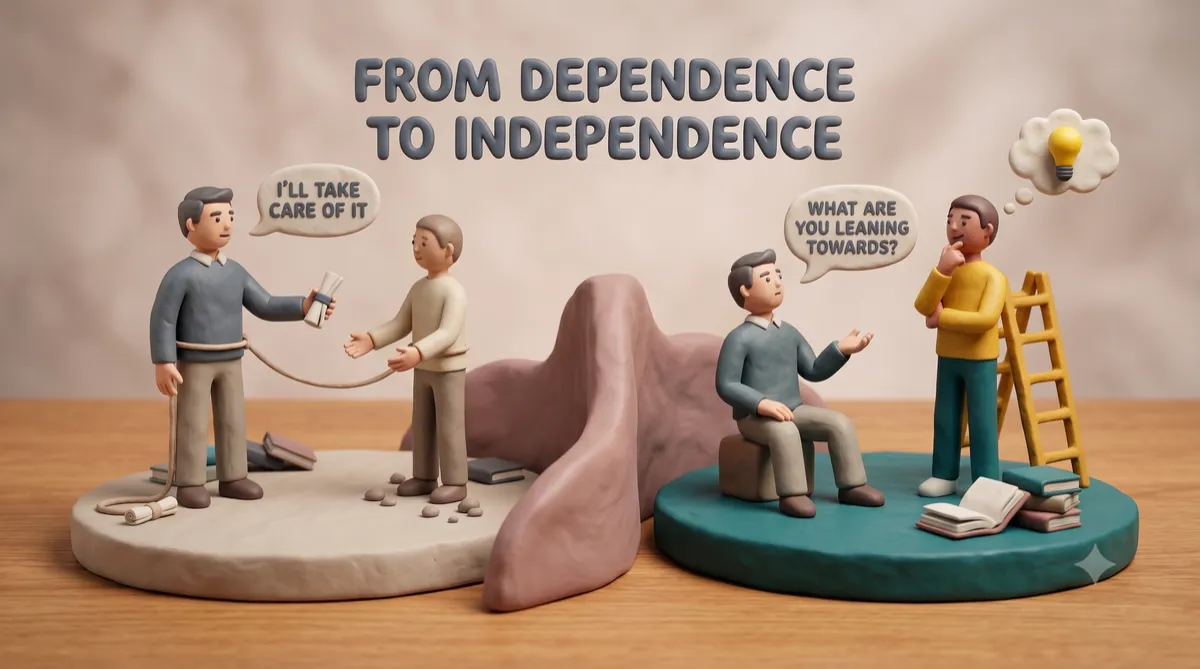
Instead, you hand it back. "Before I tell you, what are you leaning towards, and why?"
She hesitates, then commits. She would change direction. She gives her reasoning, and it is mostly sound, but there is a gap in it, a risk she has not weighed.
Here is where the challenge comes in, and where safety earns its keep. You do not fill the gap for her. You point her at it. "Good. Now what is the thing in this plan you are least sure about?"
She pauses. It is an uncomfortable pause, and you let it sit. Then she finds it. "I suppose I haven't really thought about what happens if the change doesn't help either. I don't have a next step if this fails."
There it is. She found the edge of her own reasoning, and she found it because you asked one question past where she had stopped, and because she felt safe enough to admit the gap out loud rather than defend it.
You will still add your own view before she leaves. But she now owns the decision, the reasoning, and the bit she had missed, in a way she never would have if you had simply answered "what would you do?" at the start.
Daniel Pink's work on motivation (Drive) names why this matters so much. Autonomy is one of the deepest drivers of human investment. People commit to what they own, and stay tentative about what has been handed to them fully formed. Every time you let a clinician own a decision, even a small one, even an imperfect one, you are building the thing that keeps them steady when you are not in the room. The ownership is not a nicety. It is the mechanism of independence.
The line that holds the whole series together
There is a single sentence from the Mentoring Mastery work that gathers up everything across these four posts.
If you solve it, they feel better today. If they solve it, they are better moving forward.
That is the choice, in every mentoring conversation. The immediate relief of solving it for them, or the slower, more generous work of helping them solve it themselves.
Intention sets the direction. Resisting the rescue protects the thinking. The right kind of feedback helps it land. And a calibrated challenge, held inside a safe relationship, is what finally carries a capable clinician across into an independent one. Each shift is a different way of making the same decision: to grow the clinician rather than do their thinking for them.
Try this, this fortnight
Pick one clinician you mentor, and one decision that is genuinely theirs to make.
Then do three things:
Hand it back. When they look to you for the answer, ask "what are you leaning towards, and why?" and let them go first. Their reasoning is what you are here to build, and you cannot build it if you never hear it.
Stretch them by one question. Ask the thing just past where they stopped. "What would make you change your mind?" or "What is the risk you are least sure about?" One step beyond comfortable is where the growth is.
Frame it as a stage, not a verdict. If they are not there yet, say exactly that. "Not there yet" points at a path forward. "You can't do this" closes one off. The difference is almost entirely in how safe they feel hearing it.
Then step back and let them carry it.
The aim is not to be needed less because you matter less. It is to be needed less because you did your job well.
That is where this series ends, and where the real work begins: in ordinary conversations, where you choose, again and again, to grow a clinician's thinking rather than do it for them.
Mentoring Mastery, January 2027. Five live sessions for clinicians who guide others, starting Wednesday 13 January at 8:00am or 12:15pm AEDT. The early bird price of A$797 is available until 6 January.
https://annettetonkin.com/program-structure-and-participation
Small group coaching for clinic teams. Six one-hour Zoom sessions, a fortnight apart, for up to four of your team. There is no set content. We work on the conversations your team is finding hardest.
https://annettetonkin.com/small-group-coaching-clinic-teams
Books referenced in this article
Mindset - Carol Dweck
Drive - Daniel Pink
If this is the kind of thinking you want to bring into your practice or your team, explore how I work with clinicians and clinics here: https://annettetonkin.com/program-structure-and-participation
Annette Tonkin helps experienced clinicians become more skilful, intentional mentors through her Mentoring Mastery work. You can find out more about Mentoring Mastery