
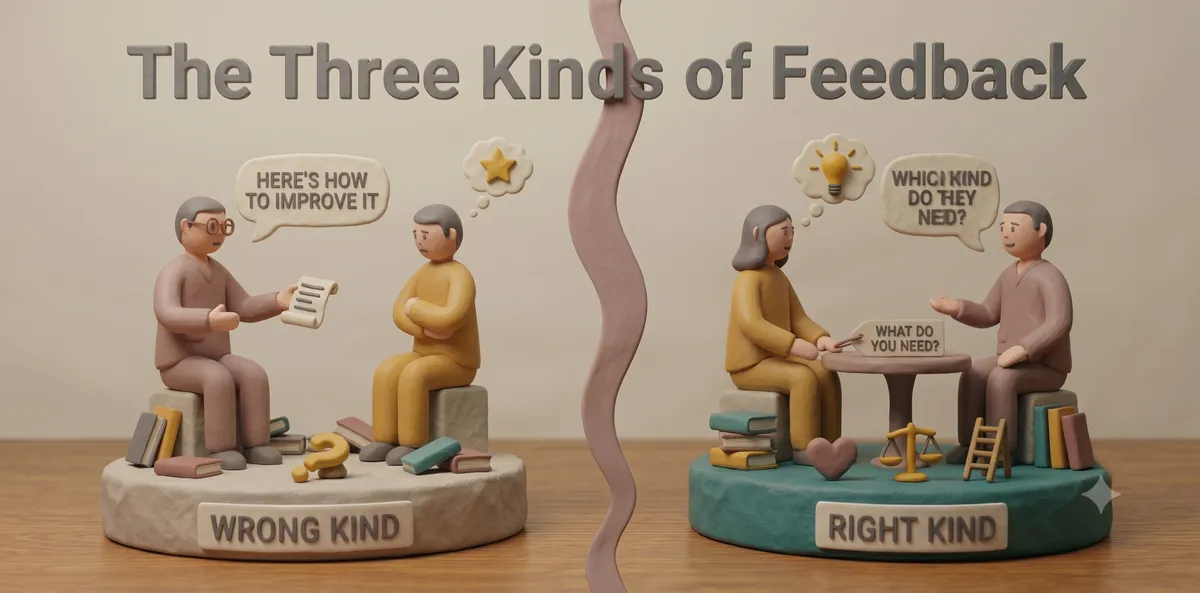
The Three Kinds of Feedback, and Why Yours Might Not Be Landing
The Mentor's Shift, Part 3
A junior writes up a complex case and brings it to you. They have clearly worked hard on it. They hand it over, and they are watching your face.
You read it, and you do what comes naturally. You start improving it. "This is good. One thing I'd tighten is the reasoning in the middle, and I'd lead with the recommendation rather than burying it."
All true. All useful. And you watch something close in their face as you say it.
They nod, say thanks, and leave. Nothing much changes in the next write-up. You are left thinking you must have been too blunt, or not blunt enough, and you resolve to word it more carefully next time.
But the wording was never the problem. You gave one kind of feedback when they needed another.
We use one word for three different things
Douglas Stone and Sheila Heen, in Thanks for the Feedback, make a point that sounds obvious the moment you hear it and changes everything once you take it seriously. We use the single word "feedback" for three quite different things.
Appreciation says: I see you, and your effort matters. It connects and motivates.
Evaluation says: here is where you stand. It rates the work against a standard.
Coaching says: here is how to grow. It is forward-looking, and it expands capability.
They feel similar in the moment, because they all arrive under the same word and often in the same conversation. But they do completely different jobs, and the person on the receiving end almost always has one of them in mind before you open your mouth. Give a different one, and it rarely lands, however well you say it.
Hear the difference
Take that junior and their case write-up, and listen to the same moment handled three ways.
As appreciation: "I can see how much thought went into this. You've stayed with a genuinely messy case and not looked away from the hard parts. That matters."
As evaluation: "This is about where I'd expect for where you are. The clinical reasoning is sound. The structure is the thing that's still developing, and it will come."
As coaching: "Here's how to sharpen it. Lead with the recommendation, let the detail follow, and tighten the reasoning through the middle section."
Three responses to one piece of work. None is wrong. But they answer three different questions, and only one of them is the question the junior was actually asking when they handed it over.
If they had spent a hard week and needed to know the effort was seen, the coaching landed as a list of faults. If they were quietly anxious about whether they are any good, the appreciation felt warm but evasive, because it dodged the question they cared about. And if they genuinely wanted to improve the write-up, the appreciation and evaluation, however kind, were beside the point.
The skill is not in any one of these phrasings. It is in knowing which one the moment calls for.
The kind mentors always reach for
Here is the trap, and it is built into being good at the job.
Experienced clinicians default to coaching. It feels productive, it sits right next to teaching, and teaching is the ground we are most comfortable on. We were trained for years to take a problem and improve it, so when a junior brings us their work, the improving starts almost on its own. Here is what I would do differently. Here is how to make it better.
Meanwhile the junior was often after one of the other two.
This is the quiet cost of clinical training. We are taught, exhaustively, how to deliver information, the explanation, the correction, the better way. We are taught almost nothing about reading which kind of response a person in front of us can actually take in. So we give the kind we are fluent in, rather than the kind that is needed, and then wonder why careful feedback keeps sliding off.
The coaching may be excellent. It still will not answer a question the junior did not ask.
Why the mismatch matters more than the wording
Most friction in feedback is not about delivery quality at all. It is about giving the wrong kind.
When the kind is wrong, coaching lands as criticism. Appreciation feels hollow, because they wanted to know where they stand and you skirted it. Evaluation stings, because they were not ready to be measured.
And the most common misfire of all is folding the three together in one breath, in the belief that you are being balanced.
"You handled that really well, but next time you might want to..." sounds even-handed. It is not. The "but" deletes everything before it, and the receiver walks away holding only the correction. The appreciation evaporates. The evaluation looms. The coaching is heard as a verdict.
There is a reason for that, and it is worth knowing. Evaluation is the loudest of the three. The moment it enters the room, even implied, even softened, the receiver tends to hear it above everything else, because the question "am I good enough?" drowns out almost any other. So if you want appreciation or coaching to land, keep the evaluation out of it. Mixed in, it is all they will hear.
Why it is the receiver who decides
This is the idea at the heart of Stone and Heen's work, and it is the one that reframes your whole job.
However skilfully you give feedback, whether it works is decided by the receiver. They control whether they take it in, how they read it, and whether anything changes as a result. The giver proposes. The receiver disposes.
That moves the question. It stops being "how do I say this well?" and becomes "what can this person actually hear right now?"
And what a person can hear is governed less by the quality of your words than by the state they are in when you say them. This is where Susan David's work on emotional agility (Emotional Agility) joins Stone and Heen so neatly. David shows that our emotional state acts as a gate on what we can process. A clinician who is flooded, defensive, depleted or quietly ashamed has very little capacity to take anything in, because the emotion is using the space the thinking would need. Feed evaluation into that state and it does not get processed. It gets defended against.
So the receiver's readiness is not a soft consideration you attend to if there is time. It is the thing that decides whether your feedback exists at all once it leaves your mouth. A brilliant piece of coaching, delivered to someone in no state to receive it, simply does not land, and no amount of careful wording rescues it.
You will recognise this, because it is the same truth that governs whether a patient acts on what you tell them. Adherence does not come from explaining more clearly. It comes from understanding the person who has to act on the explanation. Feedback works the same way. The work is not only in what you say, but in reading who is in front of you and what they can hold.
Try this, this fortnight
You do not need to overhaul how you give feedback. You need one small habit before you speak.
The next time you are about to give a junior feedback, pause for one second and ask yourself two questions:
What kind am I about to give? Appreciation, evaluation, or coaching. Name it silently. You will notice how often the honest answer is coaching, by default.
What kind do they actually need right now? Read their state as much as their work. If you genuinely cannot tell, ask: "Are you after my read on where this sits, or ideas for sharpening it?"
Then give the kind they need first, and keep the other two out of that breath.
And if feedback you gave recently did not land, run it back through the same lens. A flat or puzzled response usually means you gave the wrong kind. Heat, defensiveness or a too-quick "yes, fine" usually means the right kind at the wrong moment, when their state had the gate closed.
Name the kind before you speak. That single habit heads off most of what goes wrong with feedback, long before wording ever enters into it.
In the next post in this series, we bring the whole arc together: how to challenge a clinician hard enough to grow them without denting their confidence, and how mentoring, done well, slowly works its way out of a job.
Books referenced in this article
Thanks for the Feedback - Douglas Stone & Sheila Heen
Emotional Agility - Susan David
If this is the kind of thinking you want to bring into your practice or your team, explore how I work with clinicians and clinics here: https://annettetonkin.com/services
Annette Tonkin helps experienced clinicians become more skilful, intentional mentors through her Mentoring Mastery work. You can find out more about Mentoring Mastery.