
Why Your Cancellation Rate Is a Communication Problem, Not a Scheduling One
Most clinics treat cancellations as a logistics issue. Tighten the reminder system. Add a text the day before. Bring in a cancellation fee.
These help at the margins. But they treat the symptom, not the cause.
Because by the time a patient cancels, the decision was usually made much earlier. Not in the diary, and not in the moment they pick up the phone to call your front desk. In the room, at the last appointment, in a conversation that did not quite land.
If you want to lower your cancellation rate, the most powerful lever you have is not your booking software. It is what happens in the final ninety seconds of the consultation.
Let me show you what I mean by following one patient out the door.
A patient who cancels: how the decision actually forms
Meet a patient. Fifty-two, knee osteoarthritis, first course of supervised exercise. Call her Wednesday's four o'clock.
The appointment goes well. You assess thoroughly. You explain the diagnosis clearly. You prescribe a sensible programme and book her back in a fortnight. She nods, she thanks you, she books at the desk. By every clinical measure, a good consultation.
She walks to her car already half thinking about the rest of her week.
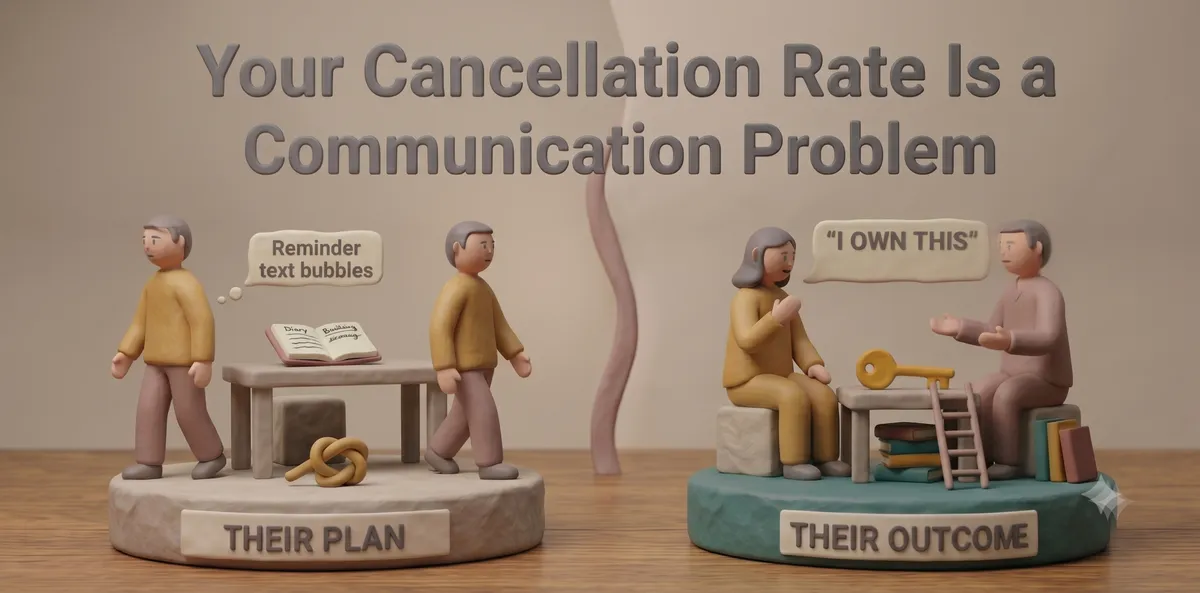
Nothing was wrong with that appointment. That is exactly the point. The plan was sound. The explanation was clear. But the plan was yours, and it stayed yours. She left with your reasons for coming back, not her own.
Watch what happens over the next twelve days.
Day three, her knee feels a little better, and a quiet thought arrives: maybe I don't need to keep going back. Day seven, work gets busy. The appointment is still in the diary, but it has no particular weight. Day ten, the reminder text lands. She reads it, and instead of confirming a thing she wants, she is now evaluating whether it is worth it. Day twelve, her daughter needs collecting at exactly the wrong time, and the appointment is the easiest thing to move.
She cancels. Politely, apologetically, with every intention of rebooking. She may never come back.
Here is the part worth sitting with. She did not decide to cancel on day twelve. She decided on day zero, in your room, the moment she left with a plan she had not made her own. The small obstacle on day twelve did not cause the cancellation. It simply collected on a decision that was already quietly made.
Why the reminder cannot save you
Now look at what the reminder text actually did in that story.
It assumed she wanted to come and had merely forgotten. For a patient who is committed, that assumption holds, and the reminder does its small, useful job.
But our patient had not forgotten. She was ambivalent. And for an ambivalent patient, a reminder does not rebuild the case for attending. It just hands them an earlier, more convenient moment to act on the doubt they were already carrying.
You cannot remind someone into caring about an outcome they never owned.
This is why clinics with genuinely excellent reminder systems still carry stubborn cancellation rates. The system is working perfectly. It is just solving the wrong problem. It is polishing the prompt while the motivation underneath was never built.
BJ Fogg (Tiny Habits) describes behaviour as firing only when three things line up at the same moment: motivation, ability, and a prompt. A reminder is a prompt, and often a good one. But a prompt with no motivation behind it has nothing to land on. The text arrives, the patient is reminded, and precisely nothing moves, because the part that was missing was never the reminder.
So the question stops being "did we remind her?" and becomes something more uncomfortable. Did she leave with a reason to come back that was actually hers?
Why a vague plan loses to a small obstacle
There is a second thing the first consultation never gave her: a concrete reason for the specific next visit.
"Come back in a fortnight" is an instruction, not a purpose. It tells her when, not what for. And a plan with no clear job is strangely easy to set aside, because there is nothing specific to weigh against the school run.
Daniel Kahneman (Thinking, Fast and Slow) helps explain why. The mind reaches for the fast, low-effort answer unless something makes the slower, considered one worth the work. A vague future appointment is effortful to evaluate, so the fast default wins, and the fast default, when something more urgent appears, is to cancel.
Compare two versions of the same booking.
"I'll see you in two weeks."
"Come back in a fortnight so we can progress your programme, because by then you should be managing the stairs without that catch, and I want to load the knee a little more once you are."
The second gives the appointment a job. The patient knows what it is for, what it is building toward, and what she will get from turning up. Now there is something concrete on the other side of the scale when the school run lands. The visit is no longer the easiest thing to move.
Now play it again, with the last ninety seconds changed
Rewind. Same patient, same knee, same sound clinical plan. Change only the final ninety seconds before she leaves.
You do three small things.
First, you ask her to say the why back to you, in her own words. "Just so we are on the same page, what are we working toward over the next few weeks?" She thinks, and she answers: "Getting up and down the stairs at work without it catching, so I can stop dreading the afternoon." That sentence matters enormously. It is hers, not yours. She has just told herself, out loud, why this is worth her time.
Second, you give the next appointment a specific job, tied to what she just said. "Good. Come back in a fortnight and we'll check those stairs and step the programme up from there." The visit now has a purpose she chose.
Third, you get an active yes. "Does that feel worth committing to?" And she says, "Yes, it does."
Twelve days later, the same daughter still needs collecting at the same awkward time. But the appointment she is now weighing is not a vague instruction from a clinician. It is a commitment she made out loud, attached to an outcome she named herself. The obstacle is the same size. The thing it is up against is far heavier.
Robert Cialdini (Influence) spent his career on why this works. People honour what they have actively, publicly committed to, far more reliably than what was merely arranged for them. A silent booking at the desk and a spoken "yes, that's worth it" look almost identical from the outside. Inside the patient, they are not the same act at all. One is an appointment. The other is a small promise to herself.
What this is really about
It would be easy to read all this as a clever retention tactic. It is not, and treating it as one will make it sound hollow when you try it.
The cancellation rate is not really a measure of your reminder system, or even your clinical skill. It is a measure of how much of the plan walks out of the room as the patient's own.
A patient follows through on an outcome they own. They drift away from one you prescribed, however expert the prescription. So the real work at the end of a consultation is not securing a booking. It is handing the outcome over, making sure the reason for coming back belongs to them and not only to you.
Do that, and the lower cancellation rate follows as a by-product. It is the visible sign of something quieter and more valuable: a patient who is genuinely invested in their own result, rather than a patient you are trying to retain.
This is communication work, and it is a clinician skill, not a front-desk one. No reminder system can do it for you, because no reminder system can hand a patient something to own.
Try this, this fortnight
Start by looking backward, then change one thing going forward.
Pull your cancellations from the last month. For each one, ask a different question than usual. Not "did we remind them?" but "did this patient leave their last visit clear on why the next one mattered to them?" Be honest about how often the answer is no.
Then, with your next few patients, change only the last ninety seconds of the consultation:
Ask them to say the why back to you."Just so we're on the same page, what are we working toward over the next few weeks?" Let them put it in their own words.
Give the next appointment a specific job. Name what it is for, not just when it is. Tie it to the outcome they just described.
Get an active yes."Does that feel worth committing to?" An out-loud agreement holds far better than a silent booking.
It takes ninety seconds. And it will do more for your cancellation rate than another reminder ever will, because it is working on the thing the reminder cannot reach.
Mentoring Mastery, January 2027. Five live sessions for clinicians who guide others, starting Wednesday 13 January at 8:00am or 12:15pm AEDT. The early bird price of A$797 is available until 6 January.
https://annettetonkin.com/program-structure-and-participation
Small group coaching for clinic teams. Six one-hour Zoom sessions, a fortnight apart, for up to four of your team. There is no set content. We work on the conversations your team is finding hardest.
https://annettetonkin.com/small-group-coaching-clinic-teams
Books referenced in this article: • Tiny Habits - BJ Fogg • Thinking, Fast and Slow - Daniel Kahneman • Influence - Robert Cialdini • How to Change - Katy Milkman
If this is the kind of thinking you want to bring into your clinic or your team, explore how I work with clinicians and clinics here: https://annettetonkin.com/services or contact me for more information
Helping patients follow through starts with the conversation in the room. To bring this into your clinic, explore the Patient Adherence & Communication Training: https://annettetonkin.com/patient-adherence--communication-training